Max@Math Revolution wrote:[Math Revolution GMAT math practice question]
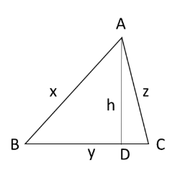
x, y and z are the sides of the triangle shown and h is its height. Is the perimeter, x + y + z of the triangle greater than 1?
1) h = 1/2
2) x = y = 1/3
$$x + y + z\,\,\mathop > \limits^? \,\,\,1$$
$$\left( 1 \right)\,\,\,\left\{ \matrix{
\,x\mathop > \limits^{\left( * \right)} \,\,\,h = {1 \over 2} \hfill \cr
\,z\mathop > \limits^{\left( * \right)} \,\,\,h = {1 \over 2} \hfill \cr
y > 0 \hfill \cr} \right.\,\,\,\,\,\,\,\,\, \Rightarrow \,\,\,\,\,\,\,x + y + z > 1\,\,\,\,\,\,\,\, \Rightarrow \,\,\,\,\,\,\,\left\langle {{\rm{YES}}} \right\rangle $$
$$\left( * \right)\,\,{\rm{in}}\,\,{\rm{any}}\,\,{\rm{given}}\,\,{\rm{right}}\,\,\Delta \,\,{\rm{,}}\,\,\,{\rm{hypotenuse}}\,\,\,{\rm{ > }}\,\,\,\,{\rm{any}}\,\,{\rm{leg}}$$

$$\left( 2 \right)\,\,\left\{ \matrix{
\,{\rm{figure}}\,\,{\rm{on}}\,\,{\rm{the}}\,\,{\rm{left}}\,\,\, \Rightarrow \,\,\,\,\,x + y + z\,\,\,\, < \,\,\,\,3\left( {{1 \over 3}} \right)\,\, = \,\,1\,\,\,\,\,\,\,\, \Rightarrow \,\,\,\,\,\,\,\,\left\langle {{\rm{NO}}} \right\rangle \hfill \cr
\,{\rm{figure}}\,\,{\rm{on}}\,\,{\rm{the}}\,\,{\rm{right}}\,\,\, \Rightarrow \,\,\,\,\,x + y + z\,\,\,\,\mathop < \limits^{{\rm{as}}\,{\rm{near}}\,\,{\rm{as}}\,\,{\rm{desired}}!} \,\,\,\,{2 \over 3} + {1 \over 3}\left( {\sqrt 2 } \right)\,\, = \,\,{{\sqrt 2 + 2} \over 3}\,\,\,\,\,\left[ { > \,\,\,1} \right]\,\,\,\,\,\,\,\, \Rightarrow \,\,\,\,\,\,\,\,\left\langle {{\rm{YES}}} \right\rangle \hfill \cr} \right.$$
The correct answer is therefore (A).
This solution follows the notations and rationale taught in the GMATH method.
Regards,
Fabio.
P.S.: it is interesting to study the case in which D does not belong to the side BC!























