BREAKING: Target Test Prep releases Brand New 2026 On Demand GMAT prep course

Redeem

The 9 squares above are to be filled with x's and o's

Expert replies
by AbeNeedsAnswers » Sat May 04, 2019 12:26 pm

Timer

00:00

Answers

A

B

C

D

E

Stats

Difficulty

Image

The 9 squares above are to be filled with x's and o's, with only one symbol in each square. How many of the squares will contain an x ?

(1) More than 1/2 of the number of squares will contain an o.
(2) Each of the 4 corner squares will contain an x.

C

Source: Official Guide 2020
Join the discussion
Source: — Data Sufficiency |

by Ian Stewart » Sat May 04, 2019 4:17 pm
From Statement 1, we know we have at least 5 O's, and therefore at most 4 X's.

From Statement 2, we know we have at least 4 X's, in the four corners.

Neither statement is sufficient, but using both, if we have at least 4 X's and at most 4 X's, we must have exactly 4 X's, and the two statements are sufficient together, so the answer is C.
For online GMAT math tutoring, or to buy my higher-level Quant books and problem sets, contact me at ianstewartgmat at gmail.com

ianstewartgmat.com
Join the discussion

by [email protected] » Mon May 13, 2019 11:49 am
Hi All,

We're told that the 9 squares above are to be filled with X's and O's, with only one symbol in each square. We're asked for the number of squares that will contain an X. This question is based around some simple Arithmetic and logic - although you might find it useful to draw a few pictures to keep organized.

(1) MORE than 1/2 of the number of squares will contain an O.

In this prompt, you cannot have a 'fraction' of a square, so MORE than 1/2 of the 9 squares means AT LEAST 5 of the 9 squares will contain an O. This means that no more than 4 of the squares can hold an X, but that could be 0, 1, 2, 3 or 4 squares.
Fact 1 is INSUFFICIENT

(2) Each of the 4 corner squares will contain an X.

With the information in fact 2, we know that AT LEAST 4 of the squares (the 4 corner squares) will contain an X, but we don't know how many total squares will hold an X; it could be 4, 5, 6, 7, 8, or 9 squares.
Fact 2 is INSUFFICIENT

Combined, we know...
-More than 1/2 of the number of squares will contain an O.
-Each of the 4 corner squares will contain an X.

Based on the possibilities we defined in each of the two Facts, the only possible value that fits BOTH Facts is "4" (re: 4 X's in the four corners and 5 O's in the other squares).
Combined, SUFFICIENT

Final Answer: C

GMAT assassins aren't born, they're made,
Rich
Contact Rich at [email protected]
Image
Join the discussion

by SampathKp » Wed Dec 18, 2019 5:13 am
AbeNeedsAnswers wrote:Image
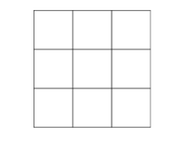
The 9 squares above are to be filled with x's and o's, with only one symbol in each square. How many of the squares will contain an x ?

(1) More than 1/2 of the number of squares will contain an o.
(2) Each of the 4 corner squares will contain an x.

C

Source: Official Guide 2020
From (1), more than half square contain an o means 5 or more squares contain an o. which means 0 to 4 squares can contain an X. This statement is NOT Sufficient.

From (2) If each corner square contains an X. Which means we have minimum of 4 out of 9 squares contining x. so 4 to 9 squares contain an x. this statement alone is NOT sfficient to answer the question.

Combining (1) and (2) We know that 5 squares contain an o and 4 corner squares contain an x . No other combination is possible. So both statements together are sufficient to answer the question.

Answer is C
Join the discussion

by Brent@GMATPrepNow » Wed Dec 18, 2019 7:16 am
AbeNeedsAnswers wrote:Image

The 9 squares above are to be filled with x's and o's, with only one symbol in each square. How many of the squares will contain an x ?

(1) More than 1/2 of the number of squares will contain an o.
(2) Each of the 4 corner squares will contain an x.

C

Source: Official Guide 2020
Given: The 9 squares above are to be filled with x's and o's, with only one symbol in each square.

Target question: How many of the squares will contain an x ?

Statement 1: More than 1/2 of the number of squares will contain an o.
This statement doesn't FEEL sufficient, so I'll TEST some values.
There are several scenarios that satisfy statement 1. Here are two:
Case a: There are 5 o's and 4 x's. In this case, the answer to the target question is 4 squares contain an x
Case b: There are 6 o's and 3 x's. In this case, the answer to the target question is 3 squares contain an x
Since we cannot answer the target question with certainty, statement 1 is NOT SUFFICIENT

Statement 2: Each of the 4 corner squares will contain an x.
There are several scenarios that satisfy statement 1. Here are two:
Case a: There are 5 o's and 4 x's. In this case, the answer to the target question is 4 squares contain an x
Case b: There are 4 o's and 5 x's. In this case, the answer to the target question is 5 squares contain an x
Since we cannot answer the target question with certainty, statement 2 is NOT SUFFICIENT

Statements 1 and 2 combined
Statement 1 tells us that the number of squares with an o = 5, 6, 7, 8 or 9, which means there are less than 5 squares with an x
Statement 2 tells us that there are at least 4 squares with an x
In other words: 4 ≤ (number of squares with an x) < 5
There is only one possible solution to the above inequality: x = 4
Since we can answer the target question with certainty, the combined statements are SUFFICIENT

Answer: C

Cheers,
Brent

Brent Hanneson - Creator of GMATPrepNow.com
Image
Join the discussion



















