pappueshwar wrote:A sequence of numbers (geometric sequence) is given by the expression:

If the sequence begins with n = 1, what are the first two terms for which

?
options:
A ) g10, g11
B)g11, g12
C) g12, g13
D) g13, g14
E) g14, g15
OA IS D
Hi pappueshwar!
I see several examples where we can plug in values so I thought I'd throw out the method that allows you to actually Solve algebraically!
Let's plug in g(n) and g(n+1) to the absolute value expression:
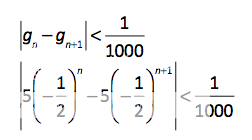
Now notice that both terms have a 5, so we can factor out that constant and move it to the other side:
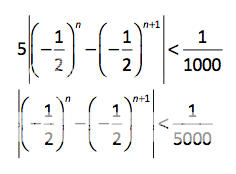
Next we have to get a bit crafty and factor out a (1/2)^n from both terms (it will leave a 1 in the first term, and for the second term, it is the same as SUBTRACTING n from the exponent, so we simply have (1/2)^1! Then we can clean that up a bit:
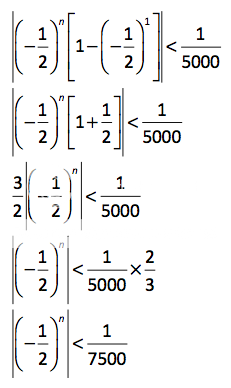
Finally, we should note that the sign on that 1/2 doesn't matter anymore because the absolute value will just strip it, so we can really just dump the negative and the absolute value symbols. Expand the exponent and cross multiply to make comparison easier...
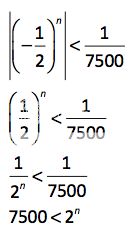
So we see that we need the value of n (the power of 2) that will make 2^n greater than 7500. The powers of 2 are:
2, 4, 8, 16, 32, 64, 128, 256, 512, 1024, 2048, 4096, 8192
**So 8192 is 2^13, so we need n=13! So the pair of g(n) and g(n+1) will be g(13) and g(14).
Sure its not the fastest method in the world but it is GREAT practice for your algebra and exponent skills!

Whit
Whitney Garner
GMAT/GRE/EA Instructor & Anxiety/Accommodations Coach
www.whitneygarner.com
Contributor to Beat The GMAT!
Math is a lot like love - a simple idea that can easily get complicated
























