BREAKING: Target Test Prep releases Brand New 2026 On Demand GMAT prep course

Redeem

Target Test Prep · GMAT

Choose how you want to prepare

Learn live with an expert or move at your own pace. Every option includes the complete TTP study system.

★★★★★5.0559 reviews
GMATLiveTeach 7 seats left
Chris Peckover
NEXT LIVE COHORT

Oct 13 to Jan 7, 2027

with Chris Peckover

Schedule
Tue, Thu · 8:00 to 10:00 PM ET
Included
40 live hours + 6 months of GMAT OnDemand
  • Live instruction and real-time questions
  • Class recordings and assigned practice
View class & enroll
Limited cohort · enrollment openTarget Test Prep
EALiveTeach 5 seats left
Logan Thompson
EXECUTIVE ASSESSMENT

Sep 6 to Dec 6, 2026

with Logan Thompson

Schedule
Sun · 9:30 AM to 12:30 PM ET
Included
40 hours of live online classes plus six months of access to the complete TTP EA OnDemand course.
  • 165+ EA Score Guarantee
  • 4,100+ Quant, Verbal, and Integrated Reasoning practice questions
  • 400+ hours of in-depth video lessons
  • 3,000+ step-by-step video solutions
View EA class & enroll
Limited cohort · enrollment openTarget Test Prep
GMATOnDemand Start anytime
SELF-PACED MASTERCLASS

Target Test Prep GMAT OnDemand

Complete access from day one. Study on your schedule.

715+ score guarantee
$0to start then $127/mo
  • Personalized study plan and analytics
  • Thousands of lessons and practice questions

Compare the format, schedule, and included access before enrolling. Prices and seat counts shown reflect the supplied offer details.

Rubik's Cube

Problem Solving — algebra and arithmetic (GMAT Focus Edition)
Expert replies
by kamalakarthi » Thu Aug 31, 2017 5:17 pm
Hi Experts,

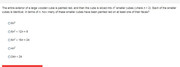
This attached problem is from One of the Manhattan CATs. While I approached this problem geometrically and wasted lot of time, I also thought this could be done thinking visually.

Is there any geometric method that I can use to solve the problem ?

Image
Join the discussion
Source: — Quantitative Reasoning |

by Matt@VeritasPrep » Thu Aug 31, 2017 5:23 pm
Think of the cube inside the cube, none of whose faces will be red.

To get to that cube inside the cube, we need to cut off a cube on either side of it. So if the larger cube is, say, 8 by 8 by 8, the cube inside will be 6 by 6 by 6. That means we'll have (8*8*8) - (6*6*6) cubes with at least one red face.

From there:

n³ - (n - 2)³ =>

n³ - (n³ - 6n² + 12n - 8) =>

6n² - 12n + 8
Join the discussion

by ErikaPrepScholar » Thu Aug 31, 2017 6:02 pm
This problem is most easily solved by visualizing the cube and plugging in simple numbers (for example, n = 3), but it can be solved geometrically, and in a couple of different ways.

Method 1

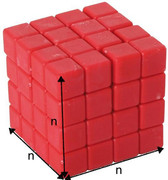
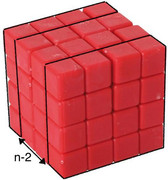
The large cube is divided into n^3 smaller cubes. This means that the dimensions of our cube are n x n x n - there are n smaller cubes along each edge.

So for this cube ...

Image

... n is 4, and there are 64 smaller cubes.

We want to know how many of the smaller cubes have at least one side painted red. In other words, we want to know how many of the smaller cubes were originally on the outside of the larger cube.

First, we can find the total number of smaller cube sides that face out. For each side of the large cube, there are n x n smaller cube sides that face out. (In our example cube above, there are 16 smaller cube sides on each large cube side.) We then have 6 larger cube sides, giving us 6n^2.

However, this means that we are double counting all of the cubes that have two sides facing out. All of the smaller cubes along the larger cube's edges have at least two sides facing out, so we can subtract n for each large cube edge. This gives us 6n^2 - 12n.

But now we see that we've unintentionally subtracted out all three sides of the smaller cubes at the corners of the large cube, so we need to add them back in. For 8 corners, that's 8 cubes, giving us 6n^2 - 12n + 8, or answer choice B.

Method 2

Alternatively, we can figure out how many smaller cubes don't have sides painted red. If we take all of the smaller cubes facing out on the larger cube off, we are left with (n-2)^3 smaller cubes. (So in our example cube, taking off all of the small cubes facing out would leave us with a 2x2x2 cube that did not have any sides painted red, or 8 smaller cubes.)

So to figure out how many cubes do have painted sides, we can subtract (n-2)^3 (the unpainted cubes) from n^3 (the total number of cubes).

n^3 - (n-2)^3
n^3 - (n^3 - 6n^2 + 12n - 8)
6n^2 + 12n - 8
Image

Erika John - Content Manager/Lead Instructor
https://gmat.prepscholar.com/gmat/s/

Get tutoring from me or another PrepScholar GMAT expert: https://gmat.prepscholar.com/gmat/s/tutoring/

Learn about our exclusive savings for BTG members (up to 25% off) and our 5 day free trial

Check out our PrepScholar GMAT YouTube channel, and read our expert guides on the PrepScholar GMAT blog
Join the discussion

by kamalakarthi » Fri Sep 01, 2017 4:12 pm
Matt,

Thanks for your reply. Say if I have a cube 8 as a side, How can I know the cube that will fit inside this cube will have side 6 upon cutting the sides of a bigger cube. Is it a generic knowledge that any cube to fit in it should be N-2 size.

I can understand from the drawing that if we have 64 same sized cubes, then the inner most 4 cubes would not have the red coloured picture.

Erika,

"If we take all of the smaller cubes facing out on the larger cube off, we are left with (n-2)^3 smaller cubes". How do I know this.

My approach to this question was , I considered 9 as a side so volume of this bigger cube is 9*9*9

and the small cube is of size 3*3*3 so the number of cubes that would fit in a bigger cube is 9*9*9/3*3*3 so I got 27 cubes. By this time, I spent around 3 mins so I made a guess.

What am I missing., Can you please help.
Join the discussion

by ErikaPrepScholar » Tue Sep 05, 2017 7:53 am
Hey kamalakarthi,

Great question. This requires some visualization.

Our initial large cube has dimensions n x n x n.

Image

All of the small cubes that DO face out (on the outside of the large cube) will have red sides. All of the cubes that DO NOT face out (on the inside of the large cube) will NOT have red sides.

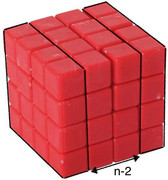
We can visualize removing all of the small cubes with red sides (the ones that face out) like so. First we need to remove all of the cubes facing out on the left and right:

Image

The original width of the cube was n. We just removed 2 cubes from the width (one on the left and one on the right). This gives us n-2 small cubes that DO NOT have red sides as our width. Then we can remove all of the cubes facing out on the top and bottom:

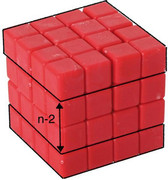
Image

Again, the original height of the cube was n, and we just removed 2 cubes from the height, giving us n-2 small cubes that DO NOT have red sides as our height. Finally, we can remove all of the cubes facing out on the front and back:

Image

This gives us n-2 small cubes that DO NOT have red sides as our length. Putting this all together, we have (n-2) x (n-2) x (n-2) small cubes that DO NOT have red sides, or (n-2)^3. We can then subtract from our original number of cubes (n^3) to solve for the number small cubes that DO have red sides:

n^3 - (n-2)^3
n^3 - (n^3 - 6n^2 + 12n - 8)
6n^2 + 12n - 8

Image

Erika John - Content Manager/Lead Instructor
https://gmat.prepscholar.com/gmat/s/

Get tutoring from me or another PrepScholar GMAT expert: https://gmat.prepscholar.com/gmat/s/tutoring/

Learn about our exclusive savings for BTG members (up to 25% off) and our 5 day free trial

Check out our PrepScholar GMAT YouTube channel, and read our expert guides on the PrepScholar GMAT blog
Join the discussion

by Matt@VeritasPrep » Wed Sep 20, 2017 4:19 pm
kamalakarthi wrote:Matt,

Thanks for your reply. Say if I have a cube 8 as a side, How can I know the cube that will fit inside this cube will have side 6 upon cutting the sides of a bigger cube. Is it a generic knowledge that any cube to fit in it should be N-2 size.

I can understand from the drawing that if we have 64 same sized cubes, then the inner most 4 cubes would not have the red coloured picture.
When you want to remove all painted cube from the larger cube, you need to remove a painted face from both sides. So if I had eight cubes before, once I remove one from both sides (the furthest on the left and the furthest on the ride), I'll be left with six cubes, or 8 - 2.
Join the discussion