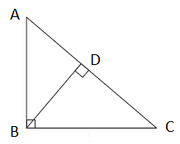
In the figure above, \(AB\) is perpendicular to \(BC\) and

This topic has expert replies
Moderator
Posts: 2599
Joined: Sun Oct 29, 2017 2:08 pm
Followed by:2 members

Timer

00:00

Your Answer

A

B

C

D

E

Global Stats

Veritas Prep

Image

In the figure above, \(AB\) is perpendicular to \(BC\), and \(BD\) is perpendicular to \(AC\). Which of the following relationships must be true?

A. \((BD)^2=(BC)^2+(AB)^2\)

B. \(\frac{1}{(BD)^2}=\frac{1}{(BC)^2}+\frac{1}{(AB)^2}\)

C. \(\frac{1}{(BD)^2}=\frac{1}{(BC)^2}-\frac{1}{(AB)^2}\)

D. \((BD)^2=(BC+AB)^2\)

E. \((BD)^2=(BC-AB)^2\)

OA B
Source: — Problem Solving |

User avatar
GMAT Instructor
Posts: 15539
Joined: Tue May 25, 2010 12:04 pm
Location: New York, NY
Thanked: 13060 times
Followed by:1906 members
GMAT Score:790

by GMATGuruNY » Wed May 29, 2019 5:18 am
AAPL wrote:Veritas Prep

Image

In the figure above, \(AB\) is perpendicular to \(BC\), and \(BD\) is perpendicular to \(AC\). Which of the following relationships must be true?

A. \((BD)^2=(BC)^2+(AB)^2\)

B. \(\frac{1}{(BD)^2}=\frac{1}{(BC)^2}+\frac{1}{(AB)^2}\)

C. \(\frac{1}{(BD)^2}=\frac{1}{(BC)^2}-\frac{1}{(AB)^2}\)

D. \((BD)^2=(BC+AB)^2\)

E. \((BD)^2=(BC-AB)^2\)

OA B
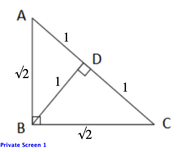
Let ∆ABD and ∆CBD each be a 45-45-90 triangle with sides 1, 1 and √2:
Image
For the figure above, only option B is true:
1/BD² = 1/BC² + 1/AB²
1/1² = 1/√2² + 1/√2²
1 = 1/2 + 1/2
1 = 1

The correct answer is B.
Private tutor exclusively for the GMAT and GRE, with over 20 years of experience.
Followed here and elsewhere by over 1900 test-takers.
I have worked with students based in the US, Australia, Taiwan, China, Tajikistan, Kuwait, Saudi Arabia -- a long list of countries.
My students have been admitted to HBS, CBS, Tuck, Yale, Stern, Fuqua -- a long list of top programs.

As a tutor, I don't simply teach you how I would approach problems.
I unlock the best way for YOU to solve problems.

For more information, please email me (Mitch Hunt) at [email protected].
Student Review #1
Student Review #2
Student Review #3

GMAT/MBA Expert

User avatar
GMAT Instructor
Posts: 8086
Joined: Sat Apr 25, 2015 10:56 am
Location: Los Angeles, CA
Thanked: 43 times
Followed by:29 members

by Scott@TargetTestPrep » Sat Jun 01, 2019 5:22 am
AAPL wrote:Veritas Prep

Image

In the figure above, \(AB\) is perpendicular to \(BC\), and \(BD\) is perpendicular to \(AC\). Which of the following relationships must be true?

A. \((BD)^2=(BC)^2+(AB)^2\)

B. \(\frac{1}{(BD)^2}=\frac{1}{(BC)^2}+\frac{1}{(AB)^2}\)

C. \(\frac{1}{(BD)^2}=\frac{1}{(BC)^2}-\frac{1}{(AB)^2}\)

D. \((BD)^2=(BC+AB)^2\)

E. \((BD)^2=(BC-AB)^2\)

OA B
Let's take AB = BC = 1. Then, by the Pythagorean theorem, AC = √(1^2 + 1^2) = √2. Using the area formula, first with AB as height and BC as base and then with BD as height and AC as base; we get that (AB)(BC) = (BD)(AC); therefore BD = 1/√2. Let's substitute AB = BC = 1 and BD = 1/√2 into each answer choice:

A) Is (1/√2)^2 = 1^2 + 1^2? No

B) Is 1/(1/√2)^2 = (1/1^2) + (1/1^2)?

Is (√2)^2 = 1 + 1? Yes

C) Is 1/(1/√2)^2 = (1/1^2) - (1/1^2)?

Is (√2)^2 = 0? No

D) Is (1/√2)^2 = (1 + 1)^2? No

E) Is (1/√2)^2 = (1 - 1)^2? No

As we can see, the only possible choice is B.

Answer: B

Scott Woodbury-Stewart
Founder and CEO
[email protected]

Image

See why Target Test Prep is rated 5 out of 5 stars on BEAT the GMAT. Read our reviews

ImageImage