The expressions can be selected in 4C2 = 6 different ways. Only one of the six possible pairs will result in a product with a quadratic equation in the form x^2 - (by)^2, namely (x - y)(x + y) = x^2 - y^2, where b=1.
BREAKING: Target Test Prep releases Brand New 2026 On Demand GMAT prep course
Redeem
Target Test Prep GMAT OnDemand
Scott Woodbury-Stewart’s private virtual classroom — 400 hours of master-class video lessons for the GMAT Focus Edition.
- 715+ score guarantee — highest in the industry (99th percentile)
- 52 chapters · 1,500+ lessons · 4,000+ practice questions
- 400 hours of video · 1,500+ instructor-led HD smartboard lessons
- 300,000+ students accepted to Harvard, Stanford, Wharton, Booth & Sloan & more
- 24/7 live support + weekly Zoom office hours with GMAT instructors
- TTP AI Assist — 24/7 AI-powered virtual tutor for instant help
- 1,200+ flashcards + AI-powered study assistant & daily calendar
- OnDemand, LiveTeach & GMAT Bootcamp formats available
- Also: GRE, SAT Math & Executive Assessment courses
- MBA Admissions Consulting now available
- 🏆 2025 EdTech Breakthrough Award: Test Prep Solution Provider of the Year
- 200,000+ students served
- 5-day free trial — $0 to start, no auto-billing, cancel anytime
★★★★★
5.0
(559 reviews)
130-pt guarantee
$0 to start
then $127/mo
If two of the four expression x+y, x+5y...
Source: Beat The GMAT — Problem Solving |
800 or bust!
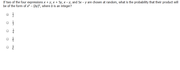
Important concept tested hereIf two of the four expressions x+y, x+5y, x-y, and 5x-y are chosen at random, what is the probability that their product will be of the form x² - (by)², where b is an integer?
A) 1/2
B) 1/3
C) 1/4
D) 1/5
E) 1/6
First recognize that x² - (by)² is a DIFFERENCE OF SQUARES.
Here are some examples of differences of squares:
x² - 25y²
4x² - 9y²
49m² - 100k²
In general, we can factor differences of squares as follows:
a² - b² = (a-b)(a+b)
So . . .
x² - 25y² = (x+5y)(x-5y)
4x² - 9y² = (2x+3y)(2x-3y)
49m² - 100k² = (7m+10k)(7m-10k)
--------------------------
From the 4 expressions (x+y, x+5y ,x-y and 5x-y), only one pair (x+y and x-y) will result in a difference of squares when multiplied.
So, the question now becomes:
If 2 expressions are randomly selected from the 4 expressions, what is the probability that x+y and x-y are both selected?
P(both selected) = [# of outcomes in which x+y and x-y are both selected]/[total # of outcomes]
As always, we'll begin with the denominator.
total # of outcomes
There are 4 expressions, and we must select 2 of them.
Since the order of the selected expressions does not matter, we can use combinations to answer this.
We can select 2 expressions from 4 expressions in 4C2 ways (= 6 ways)
If anyone is interested, we have a free video on calculating combinations (like 4C2) in your head: https://www.gmatprepnow.com/module/gmat-counting?id=789
# of outcomes in which x+y and x-y are both selected
There is only 1 way to select both x+y and x-y
So, P(both selected) = 1/6 = E
Cheers,
Brent
Hi shubh425,
This question is based heavily on algebra patterns. If you can spot the patterns involved, then you can save some time; even if you can't spot it though, a bit of 'brute force' math will still get you the solution.
We're given the terms (X+Y), (X+5Y), (X-Y) and (5X-Y). We're asked for the probability that multiplying any randomly chose pair will give a result that is written in the format: X^2 - (BY)^2.
Since there are only 4 terms, and we're MULTIPLYING, there are only 6 possible outcomes. From the prompt, you should notice that the 'first part' of the result MUST be X^2....and that there should be NO 'middle term'....which limits what the first 'term' can be in each of the parentheses....
By brute-forcing the 6 possibilities, you would have...
(X+Y)(X+5Y) = X^2 + 6XY + 5Y^2
(X+Y)(X-Y) = X^2 - Y^2
(X+Y)(5X-Y) = X^2 + 4XY - Y^2
(X+5Y)(X-Y) = X^2 + 4XY - 5Y^2
(X+5Y)(5X-Y)= 5X^2 +24XY - 5Y^2
(X-Y)(5X-Y) = 5X^2 -6XY + Y^2
Only the second option is in the proper format, so we have one option out of six total options.
Final Answer: E
GMAT assassins aren't born, they're made,
Rich
This question is based heavily on algebra patterns. If you can spot the patterns involved, then you can save some time; even if you can't spot it though, a bit of 'brute force' math will still get you the solution.
We're given the terms (X+Y), (X+5Y), (X-Y) and (5X-Y). We're asked for the probability that multiplying any randomly chose pair will give a result that is written in the format: X^2 - (BY)^2.
Since there are only 4 terms, and we're MULTIPLYING, there are only 6 possible outcomes. From the prompt, you should notice that the 'first part' of the result MUST be X^2....and that there should be NO 'middle term'....which limits what the first 'term' can be in each of the parentheses....
By brute-forcing the 6 possibilities, you would have...
(X+Y)(X+5Y) = X^2 + 6XY + 5Y^2
(X+Y)(X-Y) = X^2 - Y^2
(X+Y)(5X-Y) = X^2 + 4XY - Y^2
(X+5Y)(X-Y) = X^2 + 4XY - 5Y^2
(X+5Y)(5X-Y)= 5X^2 +24XY - 5Y^2
(X-Y)(5X-Y) = 5X^2 -6XY + Y^2
Only the second option is in the proper format, so we have one option out of six total options.
Final Answer: E
GMAT assassins aren't born, they're made,
Rich
I got one! I think.
I did 4C2 for the bottom and 1 (just the x+y and x-y pair) for the top.
prob = 1/6
That the correct way right?
Also, would the answer be different if they didn't have that part about b is an integer? I don't know why they tell us that. Also, what's the difficulty level for this?
I did 4C2 for the bottom and 1 (just the x+y and x-y pair) for the top.
prob = 1/6
That the correct way right?
Also, would the answer be different if they didn't have that part about b is an integer? I don't know why they tell us that. Also, what's the difficulty level for this?
Hi hoppycat,
Yes - the approach that you used is correct (as you might have noticed from the other responses in the thread). The 'restriction' that B must be an integer actually has no impact on the question (so the answer wouldn't change even if that information wasn't there).
GMAT assassins aren't born, they're made,
Rich
Yes - the approach that you used is correct (as you might have noticed from the other responses in the thread). The 'restriction' that B must be an integer actually has no impact on the question (so the answer wouldn't change even if that information wasn't there).
GMAT assassins aren't born, they're made,
Rich
On the modern (2017) GMAT, maybe 65th-70th percentile?hoppycat wrote:Also, what's the difficulty level for this?
Great!Matt@VeritasPrep wrote:On the modern (2017) GMAT, maybe 65th-70th percentile?hoppycat wrote:Also, what's the difficulty level for this?
First, notice that we are being tested on the difference of squares. We can restate the problem as: What is the probability when selecting two expressions at random that the product of those expressions will create a difference of two squares? Remember, the difference of two squares can be written as follows:If two of the four expressions x+y, x+5y, x-y, and 5x-y are chosen at random, what is the probability that their product will be of the form x² - (by)², where b is an integer?
A) 1/2
B) 1/3
C) 1/4
D) 1/5
E) 1/6
a^2 - b^2 = (a + b)(a - b)
So, x^2 - (by)^2 can be written as (x + by)(x - by). Thus, we are looking for two expressions in the form of (x + by)(x - by). Although this problem is attempting to trick us with the expressions provided, the only two expressions that when multiplied together will give us a difference of squares are x + y and x - y. When we multiply x + y and x - y, the result is x^2 - y^2, or x^2 - (1y)^2.
We see that there is just one favorable product, namely (x + y)(x - y). In order to determine the probability of this event, we must determine the total number of possible products. Since we have a total of four expressions and we are selecting two of them to form a product, we have 4C2, which is calculated as follows:
4C2 = (4 x 3)/(2!) = 12/2 = 6 products
Of these 6 products, we have already determined that only one will be of the form x^2 - (by)^2. Therefore, the probability is 1/6.
The answer is E.
Note: If you don't know how to use the combination formula, here is a method that will work equally well:
We are choosing 2 expressions from a pool of 4 possible expressions. That is, there are 2 decisions being made:
Decision 1: Choosing the first expression
Decision 2: Choosing the second expression
Four different expressions are available to be the first decision.
For the second decision, 3 remaining expressions are available because 1 expression was already chosen. We multiply these two numbers: 4 x 3 = 12.
The final step is to divide by the factorial of the number of decisions (2! = 2) because the order in which we multiply the expressions doesn't matter (for example, (x+y)(x-y) = (x-y)(x+y)). In this case, the two expressions are only considered as one, so we need to divide 12 by 2.
12/2 = 6
Once again the answer is E.
Alternate Solution:
One other way to solve this problem is to use probability.
Once again, we have determined that the only two expressions that when multiplied together will give us a difference of squares are x + y and x - y. If we select either of those expressions first, since there are 2 favorable expressions and 4 total expressions, there is a 2/4 = 1/2 chance that either x + y or x - y will be selected. Next, since there is 1 favorable expression left and 3 total expressions, there is a 1/3 chance that the final favorable expression will be selected.
Thus, the probability of selecting x - y and x + y is 1/2 x 1/3 = 1/6.
Answer: E

Scott Woodbury-Stewart
Founder and CEO
[email protected]

See why Target Test Prep is rated 5 out of 5 stars on BEAT the GMAT. Read our reviews