BREAKING: Target Test Prep releases Brand New 2026 On Demand GMAT prep course

Redeem

Geometry : Area problem.

Expert replies
by AndyB » Fri Apr 01, 2011 1:10 am
Hi All,

I am not able to solve the below question.Could anyone please help me in understanding with the solution:

Q)A square wooden plaque has a square brass inlay in the center, leaving a wooden strip of uniform width around the brass square.If the ratio of the brass area to the wooden area is 25 to 39, which of the following could be the width, in inches of the wooden strip?

I.1
II.3
III.4

A)I only
B)II only
C)I and II only.
D)I and III only.
E)I, II and III.
Join the discussion
Source: — Problem Solving |

by manpsingh87 » Fri Apr 01, 2011 1:48 am
AndyB wrote:Hi All,

I am not able to solve the below question.Could anyone please help me in understanding with the solution:

Q)A square wooden plaque has a square brass inlay in the center, leaving a wooden strip of uniform width around the brass square.If the ratio of the brass area to the wooden area is 25 to 39, which of the following could be the width, in inches of the wooden strip?

I.1
II.3
III.4

A)I only
B)II only
C)I and II only.
D)I and III only.
E)I, II and III.
let length of square wooden plaque be x, and length of square brass be y;
as per question, are of brass/area of wooden= 25/39;
hence y^2/x^2-y^2=25/39;
39y^2+25y^2=25x^2
x/y=8/5;
width of wooden strip would be x-y=x-5/8x=3/8x;
if x=8/3, then width=1,
if x=8, width=3;
if x=32/3, width =4;

as all values are possible, hence E
O Excellence... my search for you is on... you can be far.. but not beyond my reach!
Join the discussion

by AndyB » Fri Apr 01, 2011 2:29 am
Hi Manpsingh,

I am unable to understand the following calculation, Why are we substituting x=8/3,x=8 and x=32/3 and how we could arrive at those values only.

Could you please elucidate on this:

if x=8/3, then width=1,
if x=8, width=3;
if x=32/3, width =4;

Regards,
AndyB.
Join the discussion

by manpsingh87 » Fri Apr 01, 2011 2:33 am
AndyB wrote:Hi Manpsingh,

I am unable to understand the following calculation, Why are we substituting x=8/3,x=8 and x=32/3 and how we could arrive at those values only.

Could you please elucidate on this:

if x=8/3, then width=1,
if x=8, width=3;
if x=32/3, width =4;

Regards,
AndyB.
here important thing to understand is that x can take any value(both integral as well as non integral), that's why i'm plugging different values...!!!

i hope it helps..!!!!
O Excellence... my search for you is on... you can be far.. but not beyond my reach!
Join the discussion

by AndyB » Fri Apr 01, 2011 2:51 am
Thanks Manpsingh,

For the explanation and patience.

Regards,
AndyB
Join the discussion

by vineeshp » Fri Apr 01, 2011 2:51 am
E: 1,2 and 3.
Let us assume the side of the brass square to be x and side of the total square to be y.
and difference to be z.

If you take the unit to be 1, Area of brass square is 25 and area of whole square is 25 + 39 = 64.

So side of total square is 8.

ad side of brass is 5.

If you take two sides of this ration, you can get the same ratio of areas.
Vineesh,
Just telling you what I know and think. I am not the expert. :)
Join the discussion

by sanju09 » Fri Apr 01, 2011 3:29 am
AndyB wrote:Hi All,

I am not able to solve the below question.Could anyone please help me in understanding with the solution:

Q)A square wooden plaque has a square brass inlay in the center, leaving a wooden strip of uniform width around the brass square.If the ratio of the brass area to the wooden area is 25 to 39, which of the following could be the width, in inches of the wooden strip?

I.1
II.3
III.4

A)I only
B)II only
C)I and II only.
D)I and III only.
E)I, II and III.

If x is the side of the square wooden plaque and w is the uniform width the wooden strip, then the brass area is (x - w) ^2 and the wooden area is x^2 - (x - w) ^2; such that

(x - w) ^2: x^2 - (x - w) ^2 = 25:39 or we've

[x^2 - (x - w) ^2]/ (x - w) ^2 = 39/25 {Use componendo law and add 1 to both sides}

{[x^2 - (x - w) ^2]/ (x - w) ^2} + 1 = (39/25) + 1 gives

x^2/ (x - w) ^2 = 64/25

or, x/(x - w) = 8/5,

or (x - w)/x = 5/8,

or w/x = 3/8,

and since w and x may or may not be integers, w = 1 is possible when when x = 8/3, w = 3 is possible when x = 8, and w = 4 is also possible when x = 32/3.


[spoiler]E

The new look of the BTG page is very abstemious, thanks Eric.
[/spoiler]
The mind is everything. What you think you become. -Lord Buddha


Sanjeev K Saxena
Quantitative Instructor
The Princeton Review - Manya Abroad
Lucknow-226001

www.manyagroup.com
Join the discussion

by GMATGuruNY » Fri Apr 01, 2011 4:24 am
A square wooden plaque has a brass inlay in the center, leaving a wooden strip of uniform width around the brass square. If the ratio of the brass area to the wooden area is 25 to 39, which of the following could be the width, in inches of the wooden strip?

I. 1
II. 3
III. 4

a. I only
b. II only
c. I and II only
d. I and III only
e. I, II, and III
There is no math to be done here; just use common sense. Why couldn't the width of the strip be any value? We could choose a width for the strip, then shrink or expand the inlay until the ratio of inlay area:strip area = 25:39.

The correct answer is E.
Last edited by GMATGuruNY on Fri Apr 01, 2011 4:33 am, edited 1 time in total.
Private tutor exclusively for the GMAT and GRE, with over 20 years of experience.
Followed here and elsewhere by over 1900 test-takers.
I have worked with students based in the US, Australia, Taiwan, China, Tajikistan, Kuwait, Saudi Arabia -- a long list of countries.
My students have been admitted to HBS, CBS, Tuck, Yale, Stern, Fuqua -- a long list of top programs.

As a tutor, I don't simply teach you how I would approach problems.
I unlock the best way for YOU to solve problems.

For more information, please email me (Mitch Hunt) at [email protected].
Student Review #1
Student Review #2
Student Review #3
Join the discussion

by sanju09 » Fri Apr 01, 2011 4:31 am
GMATGuruNY wrote:
tonebeeze wrote:A square wooden plaque has a brass inlay in the center, leaving a wooden strip of uniform width around the brass square. If the ratio of the brass area to the wooden area is 25 to 39, which of the following could be the width, in inches of the wooden strip?

I. 1
II. 3
III. 4

a. I only
b. II only
c. I and II only
d. I and III only
e. I, II, and III
There is no math to be done here; just use common sense. Why couldn't the width of the strip be any value? We could choose a width for the strip, then shrink or expand the inlay until the ratio of inlay area:strip area = 25:39.

The correct answer is E.
absolutely :)
The mind is everything. What you think you become. -Lord Buddha


Sanjeev K Saxena
Quantitative Instructor
The Princeton Review - Manya Abroad
Lucknow-226001

www.manyagroup.com
Join the discussion

by Shadow88 » Fri Nov 09, 2012 1:36 am
I seem to have trouble with this type of questions. Do you guys know where i can find similar problems?
Join the discussion

by naseem_iqbal » Sat Jan 04, 2014 2:47 am
GMATGuruNY wrote:
A square wooden plaque has a brass inlay in the center, leaving a wooden strip of uniform width around the brass square. If the ratio of the brass area to the wooden area is 25 to 39, which of the following could be the width, in inches of the wooden strip?

I. 1
II. 3
III. 4

a. I only
b. II only
c. I and II only
d. I and III only
e. I, II, and III
There is no math to be done here; just use common sense. Why couldn't the width of the strip be any value? We could choose a width for the strip, then shrink or expand the inlay until the ratio of inlay area:strip area = 25:39.

The correct answer is E.

Amazing!! :)
Join the discussion

by Brent@GMATPrepNow » Sat Jan 04, 2014 7:00 am
AndyB wrote: A square wooden plaque has a square brass inlay in the center, leaving a wooden strip of uniform width around the brass square.If the ratio of the brass area to the wooden area is 25 to 39, which of the following could be the width, in inches of the wooden strip?

I.1
II.3
III.4

A)I only
B)II only
C)I and II only.
D)I and III only.
E)I, II and III.
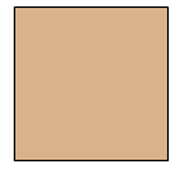
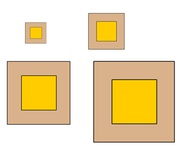
Here's a visual solution:

Let's say we want to create a plaque with a square brass inlay in the center, and we want the brass to wood ratio to be 25:39

Let's begin a square wooden board with ANY dimensions.
Image


Now place a square brass inlay in the middle of the wooden board, and keep adjusting the size of the brass inlay until we have a brass to wood ratio that is 25:39
Image

At this point, if we shrink or expand the plaque . . .
Image
. . . the brass to wood ratio will remain at 25:39

So, as you can see, this plaque can be ANY size, which means the width of the wooden strip can have ANY measurement.

Answer: E

Cheers,
Brent
Brent Hanneson - Creator of GMATPrepNow.com
Image
Join the discussion