BREAKING: Target Test Prep releases Brand New 2026 On Demand GMAT prep course

Redeem

Co-ordinate geometry

Expert replies
by DevB » Fri Jul 25, 2014 10:01 am
Hi All,

Please help in answering the attached question from GMAT Prep.

Answer options are:

1. 1/2
2. 1
3. square root 2
4. square root 3
5. (square root 2)/ 2
Thanks!
Attachments
Qs.jpg
Join the discussion
Source: — Problem Solving |

by abhasjha » Fri Jul 25, 2014 10:22 am
slope of PO = a/b
slope of QO = t/s
PO and QO is perpendicular so [a/b]*[t/s]=-1, so t/s = -b/a
In this case, b = √3, a = -1 , so t/s = [-√3]/[-1] = √3/1, so s =1

Alternatively

from the figure we can see that OP=OQ = radius of the semicircle. Also Angle POQ = 90degree

thus PQ^2 = OP^2 + OQ^2-------eqn1

using distance formula (O is origin)
OP = sqrt [(1-0)^2 + (sqrt -3 -0)^2] = sqrt [4] = 2 = OQ

also OQ = sqrt [ (s-0)^2 + (t-0)^2] = sqrt[s^2 + t^2]
OQ^2 = s^2+t^2 =4 ----eqn2

now PQ = 2sqrt 2 when we put values of OP and OQ in eqn 1

using distance formula length of PQ = sqrt [ (s+ sqrt3)^2 + (t-1)^2]
PQ^2 = (s+sqrt3)^2 + (t-1)^2 = 8--------eqn3

soving eqn 2 and 3 we get sqrt 3 s = t.Equating this in eqn 2 we get s=1
Join the discussion

by DevB » Fri Jul 25, 2014 10:35 am
Thanks a lot Abhas for the both the explanations!! :)
Join the discussion

Co-ordinate geometry

by Brent@GMATPrepNow » Fri Jul 25, 2014 10:38 am
Image

In the figure above, points P and Q lie on the circle with center O. What is the value of S?

a) 1/2
b) 1
c) √2
d) √3
e) (√2)/2
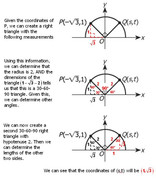
Here's one approach:
Image

So, s = 1
Answer: B

Cheers,
Brent
Last edited by Brent@GMATPrepNow on Thu Apr 19, 2018 1:34 pm, edited 1 time in total.
Brent Hanneson - Creator of GMATPrepNow.com
Image
Join the discussion

by DevB » Fri Jul 25, 2014 10:42 am
This is also a very nice approach Brent...Thanks a lot!!
Join the discussion

by [email protected] » Fri Jul 25, 2014 11:42 am
Hi DevB,

When dealing with geometry/graphing questions, there are certain patterns you should be on the lookout for:

1) A diagonal line on a graph IS the hypotenuse of a right triangle. You can draw that triangle and figure out its base and height. From there, you have a variety of triangle formulas that might be helpful involving the question.

2) The GMAT has a variety of standard formulas and patterns that it will test you on. When you come across a triangle, chances are it fits some type of pattern. Look to use the Pythagorean Theorem, and look for the special right triangles (30/60/90, 45/45/90, 3/4/5, 5/12/13).

3) Weird numbers almost always point to a pattern. Notice the (root3) in this question? I wonder what that might refer to in a right triangle....?

GMAT assassins aren't born, they're made,
Rich
Contact Rich at [email protected]
Image
Join the discussion

by Gurpreet singh » Tue Jun 07, 2016 5:21 pm
Please explain this part

In this case, b = √3, a = -1


abhasjha wrote:slope of PO = a/b
slope of QO = t/s
PO and QO is perpendicular so [a/b]*[t/s]=-1, so t/s = -b/a
In this case, b = √3, a = -1 , so t/s = [-√3]/[-1] = √3/1, so s =1

Alternatively

from the figure we can see that OP=OQ = radius of the semicircle. Also Angle POQ = 90degree

thus PQ^2 = OP^2 + OQ^2-------eqn1

using distance formula (O is origin)
OP = sqrt [(1-0)^2 + (sqrt -3 -0)^2] = sqrt [4] = 2 = OQ

also OQ = sqrt [ (s-0)^2 + (t-0)^2] = sqrt[s^2 + t^2]
OQ^2 = s^2+t^2 =4 ----eqn2

now PQ = 2sqrt 2 when we put values of OP and OQ in eqn 1

using distance formula length of PQ = sqrt [ (s+ sqrt3)^2 + (t-1)^2]
PQ^2 = (s+sqrt3)^2 + (t-1)^2 = 8--------eqn3

soving eqn 2 and 3 we get sqrt 3 s = t.Equating this in eqn 2 we get s=1
Join the discussion

by Matt@VeritasPrep » Tue Jun 07, 2016 11:13 pm
Gurpreet singh wrote:Please explain this part

In this case, b = √3, a = -1
He's using similar triangles here. Each triangle has sides of length 1 and √3, which, applied to coordinate plane, gives (-√3, 1) for the first and (1, √3) for the second.
Join the discussion

by Zoser » Thu Mar 09, 2017 9:41 am
Here's one approach:
H Brent,

Can you explain why you assumed in your solution that the second triangle is 30:60:90? like the traingle on the left?

I know the r=2 but this does not mean that the second triangle is the same as the triangle to the left.

Wham am I missing here?
Join the discussion

by GMATGuruNY » Thu Mar 09, 2017 9:51 am
Zoser wrote:
Here's one approach:
H Brent,

Can you explain why you assumed in your solution that the second triangle is 30:60:90? like the traingle on the left?

I know the r=2 but this does not mean that the second triangle is the same as the triangle to the left.

Wham am I missing here?
The three angles along the x-axis must sum to 180.
In Brent's solution, the leftmost angle along the x-axis = 30.
The figure indicates that the middle angle along the x-axis = 90.
Thus, the rightmost angle along the x-axis = 180-30-90 = 60.
Result:
The triangle on the right is also a 30-60-90 triangle.
Private tutor exclusively for the GMAT and GRE, with over 20 years of experience.
Followed here and elsewhere by over 1900 test-takers.
I have worked with students based in the US, Australia, Taiwan, China, Tajikistan, Kuwait, Saudi Arabia -- a long list of countries.
My students have been admitted to HBS, CBS, Tuck, Yale, Stern, Fuqua -- a long list of top programs.

As a tutor, I don't simply teach you how I would approach problems.
I unlock the best way for YOU to solve problems.

For more information, please email me (Mitch Hunt) at [email protected].
Student Review #1
Student Review #2
Student Review #3
Join the discussion

by Zoser » Thu Mar 09, 2017 10:12 am
The three angles along the x-axis must sum to 180.
In Brent's solution, the leftmost angle along the x-axis = 30.
The figure indicates that the middle angle along the x-axis = 90.
Thus, the rightmost angle along the x-axis = 180-30-90 = 60.
Result:
The triangle on the right is also a 30-60-90 triangle.
I dont know why I keep missing those basic concepts while answering Gmat questions! Even though, I know them but they just do not come accross my mind while solving the question!


Many thanks!
Join the discussion