BREAKING: Target Test Prep releases Brand New 2026 On Demand GMAT prep course

Redeem

Target Test Prep · GMAT

Choose how you want to prepare

Learn live with an expert or move at your own pace. Every option includes the complete TTP study system.

★★★★★5.0559 reviews
GMATLiveTeach 7 seats left
Chris Peckover
NEXT LIVE COHORT

Oct 13 to Jan 7, 2027

with Chris Peckover

Schedule
Tue, Thu · 8:00 to 10:00 PM ET
Included
40 live hours + 6 months of GMAT OnDemand
  • Live instruction and real-time questions
  • Class recordings and assigned practice
View class & enroll
Limited cohort · enrollment openTarget Test Prep
EALiveTeach 5 seats left
Logan Thompson
EXECUTIVE ASSESSMENT

Sep 6 to Dec 6, 2026

with Logan Thompson

Schedule
Sun · 9:30 AM to 12:30 PM ET
Included
40 hours of live online classes plus six months of access to the complete TTP EA OnDemand course.
  • 165+ EA Score Guarantee
  • 4,100+ Quant, Verbal, and Integrated Reasoning practice questions
  • 400+ hours of in-depth video lessons
  • 3,000+ step-by-step video solutions
View EA class & enroll
Limited cohort · enrollment openTarget Test Prep
GMATOnDemand Start anytime
SELF-PACED MASTERCLASS

Target Test Prep GMAT OnDemand

Complete access from day one. Study on your schedule.

715+ score guarantee
$0to start then $127/mo
  • Personalized study plan and analytics
  • Thousands of lessons and practice questions

Compare the format, schedule, and included access before enrolling. Prices and seat counts shown reflect the supplied offer details.

A survey was conducted to find out how many people in...

Expert replies
by swerve » Thu Dec 07, 2017 10:28 am
A survey was conducted to find out how many people in a housing colony of 144 residents could swim, dance a drive a car. It was found that the number of people who could not swim was 89, the number of people who could not dance was 100 and that the number of people who could not drive a car was 91. If the number of people who could do at least two of these things, was found to be 37 and the number of people who could do all these things was found to be 6, how many people could not do any of these things?

A) 17
B) 23
C) 29
D) 35
E) 50

The OA is D.

Please, can any expert explain this PS question for me? I have many difficulties to understand why that is the correct answer. Thanks.
Join the discussion
Source: — Problem Solving |

by Matt@VeritasPrep » Thu Dec 07, 2017 5:28 pm
When we've got three groups A, B, and C with some overlap, we can say that

Total = A + B + C + (people in no groups) - (people in exactly two groups) - 2*(people in exactly three groups)

We're told that the total = 144, A = (144 - 100), B = (144 - 89), and C = (144 - 91). (Remember that A, B, C are the people who CAN do each of the three activities, and Can = Total - Can't.)

We're also know that (people in exactly three groups) = (people in at least two groups) - (people in exactly two groups), so people in exactly three groups = 6 and people in exactly two groups = 31.

From there, our equation is

144 = (144 - 100) + (144 - 89) + (144 - 91) + (people in no groups) - 31 - 2*6

which, after some tedious arithmetic, gets us

35 = people in no groups
Join the discussion

by GMATWisdom » Fri Dec 08, 2017 9:34 am
swerve wrote:A survey was conducted to find out how many people in a housing colony of 144 residents could swim, dance a drive a car. It was found that the number of people who could not swim was 89, the number of people who could not dance was 100 and that the number of people who could not drive a car was 91. If the number of people who could do at least two of these things, was found to be 37 and the number of people who could do all these things was found to be 6, how many people could not do any of these things?

A) 17
B) 23
C) 29
D) 35
E) 50

The OA is D.

Please, can any expert explain this PS question for me? I have many difficulties to understand why that is the correct answer. Thanks.
let us take number of people who could only swim = a
...........................................................................................drive = b
...........................................................................................dance = c
...........................................................................................swim and drive = d
............................................................................................drive and dance= e
...........................................................................................dance and swim = f
..................................................................................not do any of the items= Z
number of people who know swiming+driving+dancing = 6
......................................................... at least two items = 37

therefore a+b+c+d+e+f+Z+6= 144

and d+e+f = 37 - 6 = 31

therefore a+b+c+ 31 +Z+6= 144

or a+b+c = 107- Z

those who could not swim = 89
therefore b+c+e+ Z = 89
Similaly a+c+f+ Z = 91
and a+b+d+ Z = 100
Adding we get 2(a+b+c) + (d+e+f) + 3Z =280
or 2(107-Z) + 31 + 3Z = 280

This gives Z = 280 - 214-31 = 35

Hence D is the correct answer
Join the discussion

by GMATWisdom » Sat Dec 09, 2017 11:46 am
swerve wrote:A survey was conducted to find out how many people in a housing colony of 144 residents could swim, dance a drive a car. It was found that the number of people who could not swim was 89, the number of people who could not dance was 100 and that the number of people who could not drive a car was 91. If the number of people who could do at least two of these things, was found to be 37 and the number of people who could do all these things was found to be 6, how many people could not do any of these things?

A) 17
B) 23
C) 29
D) 35
E) 50

The OA is D.

Please, can any expert explain this PS question for me? I have many difficulties to understand why that is the correct answer. Thanks.
Got a message to provide an alternative method to solve the problem.

So here it is, using set theory.

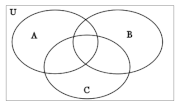
Let the set of people who can swim be A, the set of people who can dance be B and the set of people who can drive be C. The total number of people i.e. Universe set (U) in the figure below is 144.

Image

We have to find (A∪B∪C)^c where (A∪B∪C)^c is the complement of (A∪B∪C)
(A∪B∪C)^c = U- (A∪B∪C) = 144 - (A∪B∪C) ...................... equation 1.
We know that A^c = 89 or 144 - A = 89. i.e. A = 144 - 89 = 55. Similarly, B = 44 and C = 43 ...................equation 2.

In set theory, number of people in two or more sets is (A ∩ B) + (B ∩ C) + (C ∩ A) -2 (A ∩ B ∩ C) and we know that this number is 37.

We also know that (A ∩ B ∩ C) = 6 ...................equation 3.

Hence (A ∩ B) + (B ∩ C) + (C ∩ A) = 37 + 2 * 6 = 49...................equation 4.

In set theory, (A∪B∪C)=A + B + C - (A ∩ B) - (B ∩ C) - (C ∩ A) + (A ∩ B ∩ C)
Putting all the values from equation 2, 3 and 4 the above equation, (A∪B∪C) = 55 + 44+ 43 - 49 + 6 = 109 ...................equation 5.
Using equation 1 and 5
(A∪B∪C)^c = 144 - 109 = 35.

Hence D.
Join the discussion

by Jeff@TargetTestPrep » Thu Feb 22, 2018 8:30 am
swerve wrote:A survey was conducted to find out how many people in a housing colony of 144 residents could swim, dance a drive a car. It was found that the number of people who could not swim was 89, the number of people who could not dance was 100 and that the number of people who could not drive a car was 91. If the number of people who could do at least two of these things, was found to be 37 and the number of people who could do all these things was found to be 6, how many people could not do any of these things?

A) 17
B) 23
C) 29
D) 35
E) 50
We see that 144 - 89 = 55 residents could swim, 144 - 100 = 44 could dance and 144 - 91 = 53 could drive a car. We can use the formula:

Total = #(swim) + #(dance) + #(drive) - #(exactly two groups) - 2 * #(all three groups) + #(neither)

We need to find #(neither), so let's denote it by n. We have the numbers for all the other components of the formula except for #(exactly two groups). That is because the number 37 represents #(at least two groups), in other words, 37 represents #(exactly two groups) + #(all three groups). So:

37 = #(exactly two groups) + 6

31 = #(exactly two groups)

Now, we can use the formula:

144 = 55 + 44 + 53 - 31 - 2*6 + n

144 = 109 + n

35 = n

Answer: D

Jeffrey Miller
Head of GMAT Instruction
[email protected]

Image

See why Target Test Prep is rated 5 out of 5 stars on BEAT the GMAT. Read our reviews
Join the discussion