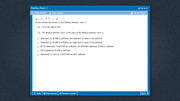
The posted problem is virtually identical to the following problem:
On the number line shown, is zero halfway between a and b
<-----------------a---------b----c----------->
1) b is to the right of zero.
2) The distance between c and a is the same as the distance between c and -b.
HALFWAY BETWEEN two values is equal to the AVERAGE of the two values.
For the average of a and b to be 0, their SUM must be 0.
Question rephrased: Does a+b = 0?
Statement 1: b>0.
No information about a.
INSUFFICIENT.
Statement 2: The distance between c and a is the same as the distance between c and -b.
The DISTANCE between x and y = |x-y|.
Thus:
|c-a| = |c-(-b)|
|c-a| = |c+b|
Case 1:
c-a = c+b
0 = a+b.
Case 2:
a-c = c+b
a-b = 2c
c = (a-b)/2.
Since a<b on the number line, a-b<0.
Since c=(a-b)/2 and a-b<0, we know that c<0.
Since c<0, and the number line implies that a<b<c, we get:
a<b<c<0.
Thus, a+b < 0.
Since in the first case a+b=0, and in the second case a+b<0,
INSUFFICIENT.
Statements 1 and 2 combined:
Since b>0, case 2 is not possible.
Thus, only case 1 is possible, implying that a+b=0.
SUFFICIENT.
The correct answer is
C.
A further exploration of Case 2:
Since c = (a-b)/2 and c>b, we get:
(a-b)/2 > b
a-b > 2b
a > 3b.
Since in case 2 a<b<c<0, the following combination of values would work:
b=-2, a=-4, c = (-4 - (-2))/2 = -1.
The distance between c=-1 and a=-4 is 3, and the distance between c=-1 and -b=2 is 3.
Alternate approach:
The number line indicates that a<b<c.
Statement 1 is clearly INSUFFICIENT.
When evaluating statement 2, test one case that also satisfies both statements and one case that satisfies only statement 2.
Statement 2: The distance between c and a is the same as the distance between c and -b.
Case 1: b=1, implying that -b = -1
Since c must be the right of b, let c=2.
The following number line is yielded:
.....-b=-1.....0.....b=1.....c=2.....
Here, -b is 3 places from c.
Thus, a must also be 3 places from c.
Since a must be to the LEFT of c, a must be 3 PLACES TO THE LEFT OF C=2.
In other words, a=-1.
Thus, -b=a=-1, yielding the following number line:
.....-b=a=-1.....0.....b=1.....c=2.....
In this case, 0 is halfway between a and b.
Case 2: b=-1, implying that -b=1
Since a must be the left of b, let a=-2.
The following number line is yielded:
.....a=-2.....b=-1.....0.....-b=1.....
Here, for c to be equidistant from a and -b, c must be halfway between them.
Since there are 3 places between a and -b, c must be 1.5 places to the right of a, yielding the following number line:
.....a=-2.....b=-1.....c=-0.5.....0.....-b=1.....
In this case, 0 is not halfway between a and b.
INSUFFICIENT.
Statements combined:
Since statement 1 requires that b>0, Case 2 is not possible.
Case 1 implies that -- when both statements are satisfied -- 0 is halfway between a and b.
SUFFICIENT.
The correct answer is
C.
Private tutor exclusively for the GMAT and GRE, with over 20 years of experience.
Followed here and elsewhere by over 1900 test-takers.
I have worked with students based in the US, Australia, Taiwan, China, Tajikistan, Kuwait, Saudi Arabia -- a long list of countries.
My students have been admitted to HBS, CBS, Tuck, Yale, Stern, Fuqua -- a long list of top programs.
As a tutor, I don't simply teach you how I would approach problems.
I unlock the best way for YOU to solve problems.
For more information, please email me (Mitch Hunt) at
[email protected].
Student Review #1
Student Review #2
Student Review #3