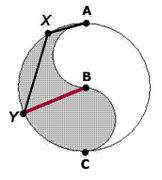
RULE:
In a quadrilateral with all four vertices on a circle, opposite angles SUM TO 180.
Let the radius of the circle = 12, implying that the area of the circle = πr² = π(12²) = 144π.

Since quadrilateral XAYC has all four vertices on the circle, ∠YXA and ∠YCA must sum to 180.
Since ∠YXA = 105, ∠YCA = 180-105 = 75.
In ∆YBC, sides BY and BC are both radii and thus are equal.
Since angles opposite equal sides of a triangle must also be equal, ∠BYC = ∠YCA = 75, with the result that ∠YBC = 180-75-75 = 30.
Yellow sector:
(central angle YBC)/360 = 30/360 = 1/12.
Since (sector area)/(circle area) = (central angle)/360, the yellow sector is 1/12 of the circle:
(1/12)(144Ï€) = 12Ï€.
Red semicircle:
Since r=6 -- implying a circle with an area of 36Ï€-- the area of the red semicircle = (1/2)(36Ï€) = 18Ï€.
Shaded area below YB:
(yellow sector) + (red semicircle) = 12Ï€ + 18Ï€ = 30Ï€.
Green sector:
(semicircle CYXA) - (yellow sector) = (1/2)(144π) - 12π = 72π - 12π = 60π.
Shaded area above YB:
Since semicircle ADB and the red semicircle have the same radius, they have equal areas (18Ï€).
Thus:
Shaded area above YB = (green sector) - (semicircle ADB) = 60π - 18π = 42π.
Resulting ratio:
(shaded area above YB)/(shaded area below YB) = (42Ï€)/(30Ï€) = 7/5.
The correct answer is
D..
Private tutor exclusively for the GMAT and GRE, with over 20 years of experience.
Followed here and elsewhere by over 1900 test-takers.
I have worked with students based in the US, Australia, Taiwan, China, Tajikistan, Kuwait, Saudi Arabia -- a long list of countries.
My students have been admitted to HBS, CBS, Tuck, Yale, Stern, Fuqua -- a long list of top programs.
As a tutor, I don't simply teach you how I would approach problems.
I unlock the best way for YOU to solve problems.
For more information, please email me (Mitch Hunt) at
[email protected].
Student Review #1
Student Review #2
Student Review #3