BREAKING: Target Test Prep releases Brand New 2026 On Demand GMAT prep course

Redeem

Target Test Prep · GMAT

Choose how you want to prepare

Learn live with an expert or move at your own pace. Every option includes the complete TTP study system.

★★★★★5.0559 reviews
GMATLiveTeach 7 seats left
Chris Peckover
NEXT LIVE COHORT

Oct 13 to Jan 7, 2027

with Chris Peckover

Schedule
Tue, Thu · 8:00 to 10:00 PM ET
Included
40 live hours + 6 months of GMAT OnDemand
  • Live instruction and real-time questions
  • Class recordings and assigned practice
View class & enroll
Limited cohort · enrollment openTarget Test Prep
EALiveTeach 5 seats left
Logan Thompson
EXECUTIVE ASSESSMENT

Sep 6 to Dec 6, 2026

with Logan Thompson

Schedule
Sun · 9:30 AM to 12:30 PM ET
Included
40 hours of live online classes plus six months of access to the complete TTP EA OnDemand course.
  • 165+ EA Score Guarantee
  • 4,100+ Quant, Verbal, and Integrated Reasoning practice questions
  • 400+ hours of in-depth video lessons
  • 3,000+ step-by-step video solutions
View EA class & enroll
Limited cohort · enrollment openTarget Test Prep
GMATOnDemand Start anytime
SELF-PACED MASTERCLASS

Target Test Prep GMAT OnDemand

Complete access from day one. Study on your schedule.

715+ score guarantee
$0to start then $127/mo
  • Personalized study plan and analytics
  • Thousands of lessons and practice questions

Compare the format, schedule, and included access before enrolling. Prices and seat counts shown reflect the supplied offer details.

How many integers between 50 and 100, inclusive, are divisi

Expert replies
by Max@Math Revolution » Thu Jun 07, 2018 1:34 am

Timer

00:00

Answers

A

B

C

D

E

Stats

Difficulty

[GMAT math practice question]

How many integers between 50 and 100, inclusive, are divisible by 2 or 3?

A. 35
B. 37
C. 42
D. 47
E. 52
Join the discussion
Source: — Problem Solving |

by GMATGuruNY » Thu Jun 07, 2018 2:20 am
Max@Math Revolution wrote:[GMAT math practice question]

How many integers between 50 and 100, inclusive, are divisible by 2 or 3?

A. 35
B. 37
C. 42
D. 47
E. 52
Total integers = (multiples of 2) + (multiples of 3) - (multiples of both 2 and 3).

For any evenly spaced set:
Count = (biggest - smallest)/increment + 1.
The INCREMENT is the difference between one value and the next.

Multiples of 2 between 50 and 100, inclusive:
Smallest = 50.
Biggest = 100.
Increment = 2.
Count = (100-50)/2 + 1 = 26.

Multiples of 3 between 50 and 100, inclusive:
Smallest = 51.
Biggest = 99.
Increment = 3.
Count = (99-51)/3 + 1 = 17.

Multiples of both 2 and 3 between 50 and 100, inclusive:
An integer divisible by both 2 and 3 is a MULTIPLE OF 6.
Thus:
Smallest = 54.
Biggest = 96.
Increment = 6.
Count = (96-54)/6 + 1 = 8.

Total integers = 26 + 17 - 8 = 35.

The correct answer is A.
Private tutor exclusively for the GMAT and GRE, with over 20 years of experience.
Followed here and elsewhere by over 1900 test-takers.
I have worked with students based in the US, Australia, Taiwan, China, Tajikistan, Kuwait, Saudi Arabia -- a long list of countries.
My students have been admitted to HBS, CBS, Tuck, Yale, Stern, Fuqua -- a long list of top programs.

As a tutor, I don't simply teach you how I would approach problems.
I unlock the best way for YOU to solve problems.

For more information, please email me (Mitch Hunt) at [email protected].
Student Review #1
Student Review #2
Student Review #3
Join the discussion

by Scott@TargetTestPrep » Fri Jun 08, 2018 10:22 am
Max@Math Revolution wrote:[GMAT math practice question]

How many integers between 50 and 100, inclusive, are divisible by 2 or 3?

A. 35
B. 37
C. 42
D. 47
E. 52
For this problem, we must recall that to calculate the number of integers in a range of values that are divisible by a certain number n, we use the formula: (largest multiple - smallest multiple)/n + 1. For example, to calculate the number of integers between 10 and 29 that are divisible by 3, we see that 27 is the largest multiple of 3 in that range of numbers, and 12 is the smallest multiple of 3. Thus, we have (27 - 12)/3 + 1 = 15/3 + 1 = 6.

The number of integers from 50 to 100, inclusive, that are divisible by 2 is:

(100 - 50)/2 + 1 = 26

The number of integers from 50 to 100, inclusive, that are divisible by 3 is:

(99 - 51)/3 + 1 = 17

Now we need to subtract the overlap, that is, we have to subtract the number of multiples of 6 because multiples of 6 were counted as both multiples of 2 and multiples of 3.

The number of integers from 50 to 100, inclusive, that are divisible by 6 is:

(96 - 54)/6 + 1 = 8

Thus, the number integers between 50 and 100, inclusive, that are divisible by 2 or 3 is 26 + 17 - 8 = 35.

Answer: A

Scott Woodbury-Stewart
Founder and CEO
[email protected]

Image

See why Target Test Prep is rated 5 out of 5 stars on BEAT the GMAT. Read our reviews

ImageImage
Join the discussion

edit

by Max@Math Revolution » Sun Jun 10, 2018 5:18 pm
=>

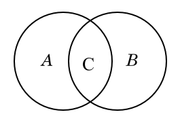
Let A be the set of integers between 50 and 100 that are divisible by 2.
Let B be the set of integers between 50 and 100 that are divisible by 3.
Let C be the set of integers between 50 and 100 that are divisible by both 2 and 3. This is the same as the set of integers between 50 and 100 that are divisible by 6. Then
A = { 50, 52, ..., 100 }
B = { 51, 54, ..., 96, 99 }
C = { 54, 60, ..., 96 }

The number of elements of the set A is |A| = ( 100 - 50 ) / 2 + 1 = 26.
The number of elements of the set B is |B| = ( 99 - 51 ) / 3 + 1 = 17.
The number of elements of the set C is |C| = ( 96 - 54 ) / 6 + 1 = 8.
Using a Venn diagram, we can see that we need to find |A| + |B| - |C| as the integers in the intersection of sets A and B are counted twice.


Image


|A| + |B| - |C| = 26 + 17 - 8 = 35.

Therefore, the answer is A.

Answer : A
Join the discussion