BREAKING: Target Test Prep releases Brand New 2026 On Demand GMAT prep course
RedeemThe Importance of Getting to 'No' on the GMAT - Part 1
 Recently, a colleague of mine shared this very interesting puzzle published by The New York Times. (Thanks, Ceilidh!)
Go ahead and try it. Ill wait. After youve tried the puzzle, you can read the short article that goes with it.
What did you learn about how humans tend to think? More important, what did you learn about how you think?
That tendency to look for the no, or to try to disprove something, is a trait shared by scientists, devils advocates, and great standardized test takers. You can learn to make this your natural reaction, too!
Try this Data Sufficiency (DS) problem from the free GMATPrep exams. (Note: if you have not yet taken your two free GMATPrep exams, you may want to wait until youve done so before you read further. Also, if you have not yet studied DS enough to know what the five answer choices are, bookmark this article and come back to it after you have memorized the DS answer choices.)
*Is x less than 20?(1) The sum of x and y is less than 20.
(2) y is less than 20
Ready?
Heres our framework for working through a GMAT problem:
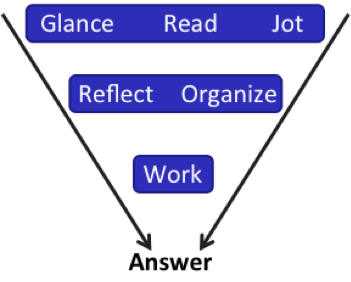
Glance: Its a DS problem. WordsIll have to do a little translating. Doesnt seem to be a big story, though.
Read: Its a yes/no question, so I dont necessarily have to find the exact value of x.
Jot:
Is x < 20?
Reflect: They havent actually told me anything about x. The value could be anything: negative, 0, a fraction.
Jot some more and Organize. The two statements are pretty easy, so I chose to translate both at once, before starting to work on them:
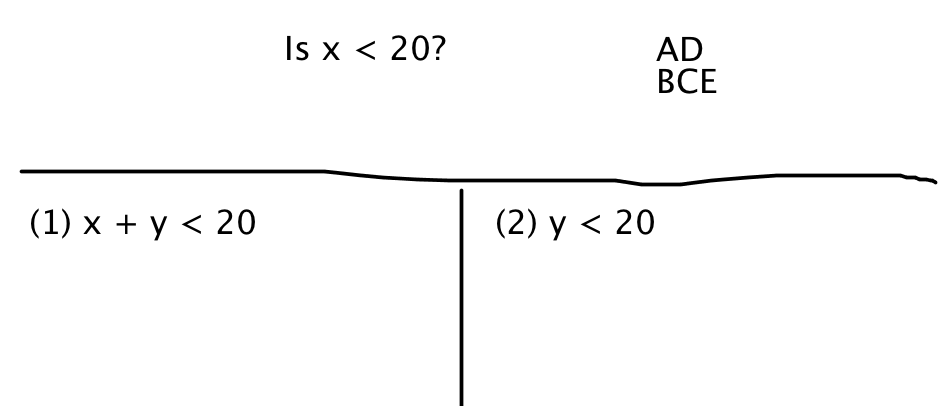
Note: Although statement (2) is arguably easier, statement (1) isnt really hard. My default is to start with statement (1) unless it looks ugly or annoying, so Im starting with statement (1).
Reflect again, then Work. What should I do with statement (1)? I can test cases:
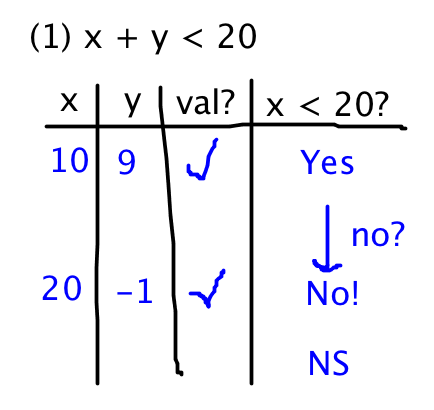
Look what I did there. The first case that I tested did give me a Yes answer. But then I didnt just pick any random number to try for my second case. I thought, Hey, what could give me the opposite answer? I want to find a No, if possible!
(By the way, that val? column is short for valid? Its crucial to make sure that you choose numbers that make the statement valid. Otherwise, discard that case!)
Okay, so statement (1) is not sufficient (NS); eliminate answers (A) and (D). What about statement (2)? It doesnt even mention x, so its not sufficient either. Eliminate answer (B). Put the two statements together.
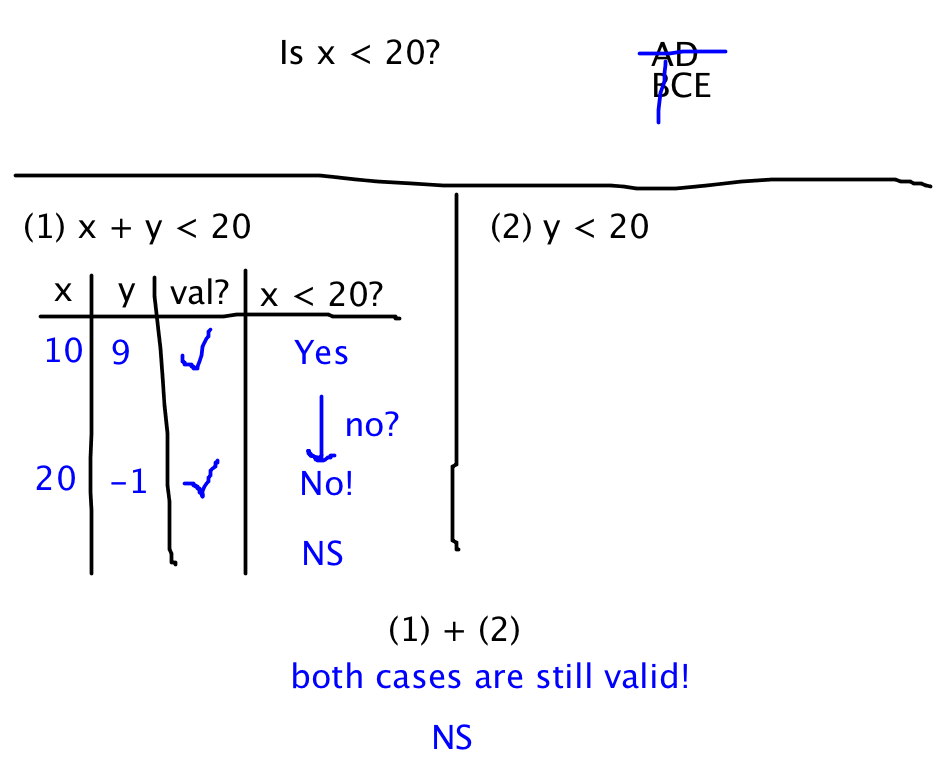
Check it out! The first two cases for statement (1) still work even when you add statement (2) to the mix. Even together, the two statements are not sufficient to answer the question.
The correct answer is (E).
Try this one (also from GMATPrep) and well talk about it next time:
*If 0 < r < 1 < s < 2, which of the following must be less than 1?I.[pmath]r/s[/pmath]
II. rs
III. s r
(A) I only
(B) II only
(C) III only
(D) I and II
(E) I and III
Key Takeaways for Getting to No:
(1) Your job is to be a skeptical scientist. What better way to confirm your theory than to try to disprove it as rigorously as you can? If you can find a valid case that gives a No answer, as well as a case that gives a Yes answer, then youre done: this statement is not sufficient to answer the question.
(2) If you are actively trying to disprove and you cant, then the chances are pretty good that this statement is actually sufficient. Yes, it might be the case that you have just not found the right number to test yet. But if you are actively trying to disprove, then your brain will be thinking about the weird numbers that might make a differenceso you can feel pretty confident that youve probably got it.
* GMATPrep questions courtesy of the Graduate Management Admissions Council. Usage of this question does not imply endorsement by GMAC.