BREAKING: Target Test Prep releases Brand New 2026 On Demand GMAT prep course
RedeemHow to Tackle Every Single GMAT Problem (Seriously!) - Part 3
 Welcome to part 3 of our series on how to answer every single GMAT problem youll ever see. :) If you havent already read the earlier installments, start with part 1 and work your way back to me.
This time, were going to test out the process with a GMATPrep Sentence Correction question from the free exams. Here you go:
In archaeology, there must be a balance between explanation of the value and workings of archaeology, revealing the mysteries of past and present cultures, and to promote respect for archaeological sites.(A) between explanation of the value and workings of archaeology, revealing the mysteries of past and present cultures, and to promote
(B) among explaining the value and workings of archaeology, revealing the mysteries of past and present cultures, and promoting
(C) between explaining the value and workings of archaeology, the revealing of the mysteries of past and present cultures, and when promoting
(D) among explaining the value and workings of archaeology, the revelation of the mysteries of past and present cultures, and to promote
(E) between explaining archaeologys value and workings, in the revealing of the mysteries of past and present cultures, and in promoting
Got your answer? Lets do this!
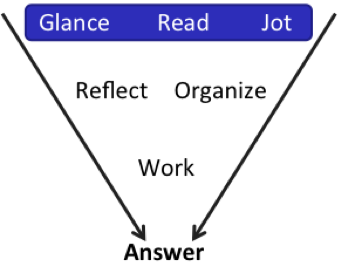
First, Glance at the problem. What does that even mean for SC? Theres so much text!
Dont read the sentence yet. Heres where to glance:
- Start with the word before the underline and the first underlined word
- Then glance down the first word or two of each answer choice
Thats it! Now what do you do with that information?
Some words are markers all by themselves: if you see the word and, you know something is going on with parallelism.
Other clues make themselves known when you compare differences in the answers, and theres always one difference at the beginning of each answer choice. You may not always know what the difference signifies, but if you train well, you can learn to spot clues on a First Glance something like 70% to 80% of the time.
Why do this before you even read the sentence? On SC, its often hard to find a starting point, since each sentence could be testing anything and just what its testing is not always obvious. Sometimes you read a sentence and just shrug, not sure whats going on. If your first glance can provide you with a valuable clue as to what is being tested (or what might be tested), then you can read that sentence with a point of view: youre actively looking for a particular issue. That will more quickly point you towards at least one of the issues going on in the sentence!
So go back up and glance at that problem right now. What do you notice?
balance between
The word between is part of the idiom between X and Y. Less commonly, you may see a split in the answers between between and among. (See what I just did there? :)) Glance down the beginning of the answers yep, this one is testing between vs. among. Id jot down between/among on my scrap paper. (Actually, Id use shorthand and write bet/am. I know what this means because Ive used this abbreviation before.)
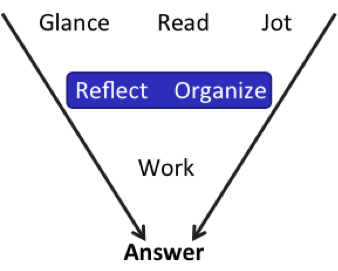
Excellent! Im jumping to Reflect because my Glance actually gave me something to think about. Do you know how those two words are used? Between is used when talking about exactly two things; among is used for three or more things. Now I know what to think about when I go back up for my next step: Read.
Okay, the sentence has a list of three: explanation, revealing, and to promote. I know immediately that between is wrong; I need to choose an answer that uses among. Also, this construction requires parallelism and that list does not look very parallel. Ill come back to that in a minute.
Work! Cross off answers (A), (C), and (E). That was niceonly two to go. Now lets go back to check out that parallelism issue.
(B) among explaining the value and workings of archaeology, revealing the mysteries of past and present cultures, and promoting(D) among explaining the value and workings of archaeology, the revelation of the mysteries of past and present cultures, and to promote
Answer (B)s list items are explaining, revealing, and promoting. Looking nicely parallel!
Answer (D)s list items are explaining, the revelation, and to promote. A participle, a noun, and an infinitive verb: not parallel! (An ing word can be a noun or a verb, but a noun and an infinitive verb cannot be parallel to one another.)
The correct answer is (B). And I barely had to read anything among those five long answer choices. (See what I did again there? :))
You may have noticed that, on SC, we have to back and forth between the steps of the process a lot. This is one of the annoying parts of SC. Every time you get a clue, you figure out what it means (Reflect & Organize!) and cross off some answers (Work!), but then you typically have to go back and start all over again. One clue typically wont allow you to cross off all four wrong answers (though this does happen sometimes).
In fact, we incorporate these ideas into our 4-step SC Process. (Yes, I know that the article I just linked technically lists 5 steps but the fifth step is really just repeat.)
Try the process out again on the GMATPrep problem below and Ill give you the answer in our next installment.
The new image of Stone Age people as systematic hunters of large animals, rather than merely scavenging for meat, have emerged from the examination of tools found in Germany, including three wooden spears that archaeologists believe to be about 400,000 years old.(A) merely scavenging for meat, have emerged from the examination of tools found in Germany, including
(B) as merely scavenging for meat, have emerged from examining tools found in Germany, which include
(C) as mere meat scavengers, has emerged from examining tools found in Germany that includes
(D) mere scavengers of meat, has emerged from the examination of tools found in Germany, which includes
(E) mere scavengers of meat, has emerged from the examination of tools found in Germany, including
Key Takeaways for Every Problem You Will Ever Do:
(1) First, you want to see whether a quick look can give you an early idea of one topic the sentence may be testing. Glance at the word right before the underline and at the first word of the underline: any clue markers there? Next, compare the first word or two of each answer choice: do the differences signal any particular issues?
(2) If so, Reflect briefly on what is or might be happening, then Read the original sentence, Jotting down any important markers or reminders as you go. When youve found a starting point, Reflect again to decide what to do with this piece of information.
(3) When you know youve got an error, cross off that answer choice and any others that repeat the same error. As you do this, keep an eye out for clues that can help you find the next starting point, as in this problem when the first clue (between / among) led me to the second issue (parallelism). After several rounds, youll either be down to one answer or youll realize that this one is too hard and youll guess from among the remaining choices.
* GMATPrep questions courtesy of the Graduate Management Admissions Council. Usage of this question does not imply endorsement by GMAC.