BREAKING: Target Test Prep releases Brand New 2026 On Demand GMAT prep course
RedeemWant a 750+? Do This Question in Less Than 60 Seconds.
 Recently, I published an article challenging those going for a 750+ to answer a certain quant question in 30 seconds. I received a lot of positive feedback about that article and requests for more of the same.
Im happy to oblige: heres a GMATPrep CR problem. The normal timeframe is about 2 minutes but if youre going for a 750+, youd need to be able to answer something like this much more quickly.
Correctly measuring the productivity of service workers is complex. Consider, for example, postal workers: they are often said to be more productive if more letters are delivered per postal worker. But is this really true? What if more letters are lost or delayed per worker at the same time that more are delivered?The objection implied above to the productivity measure described is based on doubts about the truth of which of the following statements?
(A) Postal workers are representative of service workers in general.(B) The delivery of letters is the primary activity of the postal service.
(C) Productivity should be ascribed to categories of workers, not to individuals.
(D) The quality of services rendered can appropriately be ignored in computing productivity.
(E) The number of letters delivered is relevant to measuring the productivity of postal workers.
Got your answer? Lets start going through this one! (Note: if you arent yet familiar with the 4-step process for answering CR questions, take a look at this article.)
Step 1: Identify the Question
This question stem is unusual it doesnt actually contain the typical markers that wed expect to see on a CR problem. That fact makes this question harder and its also the key to cracking the question if we want to have a hope of answering it correctly at all, let alone very quickly.
This question stem actually contains a wealth of information! The first few words tell us that theres some kind of opinion and counter-opinion in the argument (someone is objecting to something) but that counter-opinion is only implied, not stated outright.
Hmm. What kind of information is implied but not stated in an argument? Assumptions thats one possibility. But imply language can also point to inference questions. Keep reading.
Next we learn that some sort of productivity measure is described in the argument. If someone is objecting to whatever this thing is, then presumably theres some kind of conclusion about the productivity measure. Assumption Family questions do have to contain conclusions, while Inference questions dont, so were building evidence here for some kind of assumption question.
Finally, the question tells us that this implied objection is based on doubts about the truth of something. The objection must be based on something about the argument in general the premise, the conclusion, or an assumption used to draw the conclusion. Further, because the question stem asks about the truth of something, its got to be either a premise or an assumption (since the conclusion itself is always a claim). All of this evidence is pointing us towards a Find the Assumption question.
If you want to answer this one correctly, then you need to get to this point in general. If you want to answer it correctly and quickly, you need to be able to decode this within about 15-20 seconds.
Step 2: Deconstruct the Argument
All right, weve got an assumption question. I need to find the conclusion and try to brainstorm assumptions.
Here, Ill show you what Im thinking while I read the argument and also how I would take notes. Your own thought process wont be exactly the same as mine and, of course, your notes will probably look quite different, since we all have our own ways of abbreviating things.

Heres the key: there are two separate people / groups arguing here. The first (unnamed) group believes that the measure of letters per worker delivered indicates how productive the workers are: the more l/w delivered, the more productive. (Lets call this the original argument just to keep things straight.)
The author of this particular argument, though, isnt so sure thats valid and his objection is implied in that last question. (Lets call this the authors objection.)
Now, whats the assumption of the people with the main argument here? This is really important: Im trying to figure out what some people are assuming, not what the objector is assuming. The objector doubts the truth of an assumption made by that initial unnamed group.
Maybe theyre assuming that an increase in the number of letters per worker will not result in any bad consequences, such as a higher number of lost letters. Or maybe theyre simply assuming that measures of other things, including bad consequences, dont matter at all the only thing that matter is the number of letters delivered per worker.
Step 3: State the Goal
This is an assumption question, so I have to find something that the proponents of the original conclusion MUST believe to be true in order to draw this conclusion (that a greater number of letters delivered per worker = more or better productivity).
Work from Wrong to Right
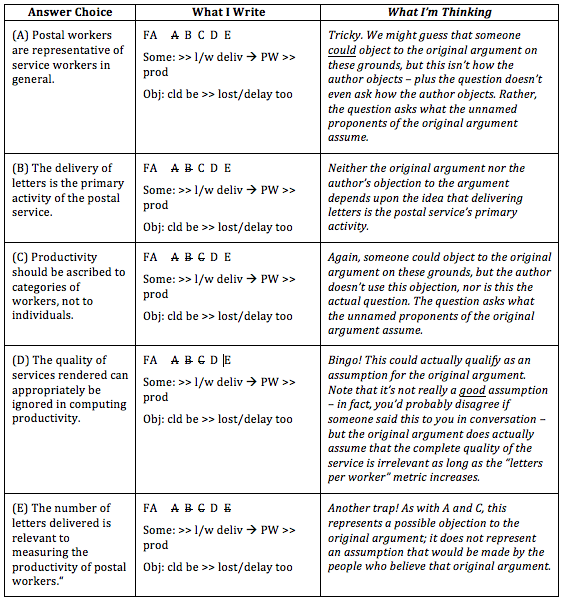
The correct answer is D.
Notice something very important: 3 of the 4 wrong answers represented things that the author could have used to oppose the argument but that wasnt what the question asked. Why do so many of the wrong answers come in this same format? Its precisely because the question stem is so tricky / difficult to read. If someone reads just the first few words of the question stem (the objection implied above) and then starts skimming or losing concentration or just glazing over the words, he or she is going to think that the question is about an objection to the argument. Instead, theyre asking for essentially the opposite: an assumption that would help to make the argument true!
Take-aways for CR questions with Unusual Question Stems:
(1) In general, know the common ways to identify each question type. When you get to a strangely-worded question stem, use what you do know about each question type to help decode the weird question stem.
(2) In this case, several clues in the question stem helped us pinpoint the question as a Find the Assumption type. You could even pretend that youre arguing with someone and try to re-word the question stem in a more me against you way (pretending that youre the author)
Original question: "The objection implied above to the productivity measure described is based on doubts about the truth of which of the following statements?"Re-wording: The objection I made to your argument is based on my doubts about the truth of what you believe. What you believe is in one of the following statements.
(3) When the question stem is unusual at all, take a little more time to pick it apart! (And make sure to practice these very carefully in advance.) The wrong answers are more likely to be based on a bad reading of the question stem. In this case, someone might think that the question is asking about the objection itself and three of the wrong answers would be tempting!
* GMATPrep questions courtesy of the Graduate Management Admissions Council. Usage of this question does not imply endorsement by GMAC.