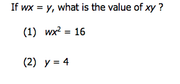
Mustbeatquant wrote:Thanks for that alternative approach, Mitch. I'm a big fan of plugging in numbers for variables, but in this case I was reluctant to do so because there were three variables. Happy to see it is possible and a viable alternative to the above solution.
Quick questions: When you first saw this problem, what made you go with your approach rather than the one described by Brent. My biggest issue with quant is recognizing the skill being tested on each problem, so it'd be helpful to gain a bit of insight into your thought process.
Thanks again for your time and help!
How many men attended the party?
What was the selling price of the dress?
What is the value of xy?
All of these questions ask for a SPECIFIC VALUE.
When a DS problem asks for a specific value, one way to evaluate the statements is to TEST CASES.
If the value stays the same in each case, the statement is SUFFICIENT.
If the value changes, the statement is INSUFFICIENT.
Many of these problems can also be solved algebraically.
The GMAT is designed to allow for different approaches.
Use whichever approach works best for you.
In the problem above, one more way to evaluate statement 1 is to divide one equation (wx² = 16) by the other (wx = y):
wx²/wx = 16/y
x = 16/y
xy = 16.
Private tutor exclusively for the GMAT and GRE, with over 20 years of experience.
Followed here and elsewhere by over 1900 test-takers.
I have worked with students based in the US, Australia, Taiwan, China, Tajikistan, Kuwait, Saudi Arabia -- a long list of countries.
My students have been admitted to HBS, CBS, Tuck, Yale, Stern, Fuqua -- a long list of top programs.
As a tutor, I don't simply teach you how I would approach problems.
I unlock the best way for YOU to solve problems.
For more information, please email me (Mitch Hunt) at
[email protected].
Student Review #1
Student Review #2
Student Review #3