das.ashmita wrote:Each of the following equations has at least one solution EXCEPT
-2^n = (-2)^(-n)
2^(-n) = (-2)^n
2^n = (-2)^(-n)
(-2)^n = -2^n
(-2)^(-n) = -2^(-n)
OA A
Hi das.ashmita!
The best place to start is by re-writing the choices on your paper so we don't confuse the parenthesis:
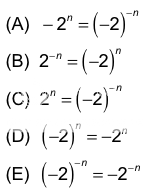
Okay, so we need to find which of these does NOT have a solution - that means that there is NO value of n that would make this true. Hmmm, that also means that 4 of these WILL be true for at least some value of n. Which would be easier to find?
Well, we could try to simplify/solve these equations by grouping term, etc. But this is the GMAT right, so the easiest thing to do is probably to quickly try a couple of LIKELY numbers to try to eliminate choices. For example, what if N=0? A power of 0 makes any base 1 so that should be easy to work through. Just make sure you're careful with those parenthesis - if the negative is not in parenthesis WITH the base, then you take the exponent FIRST and then apply the sign!
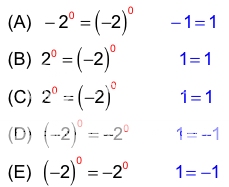
Well, we see that choices B and C are equal when n=0, which means when n=0 they are TRUE, so they have solutions!! We can eliminate them!
Now let's see if we can try another easy number, n=1. When n=1, the base stays the same, but when n=-1 we just put the base under 1 in a fraction. We don't have to test B and C but I will just to be complete!
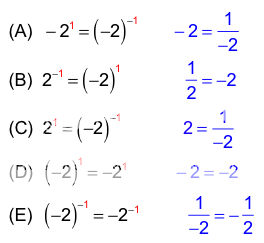
So in this scenario, choices D and E are equal when n=1, which means they have a solution!! We can eliminate them!
So now we can put this all together - we can eliminate B/C because they are true when n=0, and we can eliminate D/E because they are true when n=1. So that only leaves
A!
Hope this helps!

Whit
Whitney Garner
GMAT/GRE/EA Instructor & Anxiety/Accommodations Coach
www.whitneygarner.com
Contributor to Beat The GMAT!
Math is a lot like love - a simple idea that can easily get complicated
























