BREAKING: Target Test Prep releases Brand New 2026 On Demand GMAT prep course

Redeem

Want simple explanation for this PS question on Ratios

Expert replies
by dhiren8182 » Sat Jan 17, 2015 7:28 pm
The ratio of two positive numbers is 3 to 4. If k is added to each number the new ratio will be 4 to 5, and the sum of the numbers will be 117. What is the value of k?
Ans Choices
1
13
14
18
21
OA 13
Not able to figure out on how my approach should be
Regards,
Dhiren
Join the discussion
Source: — Problem Solving |

by Brent@GMATPrepNow » Sat Jan 17, 2015 9:16 pm
dhiren8182 wrote:The ratio of two positive numbers is 3 to 4. If k is added to each number the new ratio will be 4 to 5, and the sum of the numbers will be 117. What is the value of k?
Ans Choices
A) 1
B) 13
C) 14
D) 18
E) 21
The ratio of two positive numbers is 3 to 4.
Let 3x = the smaller number
Let 4x = the larger number

Aside: Notice that this ensures that their ratio will equal 3/4, since 3x/4x = 3/4

If k is added to each number the new ratio will be 4 to 5 . . .
When k is added to each value, the NEW values are 3x + k and 4x + k
So, (3x + k)/(4x + k) = 4/5
Cross multiply to get: 16x + 4k = 15x + 5k
Rearrange terms to get: x = k


. . . and the sum of the numbers will be 117
The two NEW values are 3x + k and 4x + k
So, we can write: (3x + k) + (4x + k) = 117
Simplify to get 7x + 2k = 117

Since x = k, we can take the above equation and replace x with k to get...
7k + 2k = 117
Simplify: 9k = 117
Solve: k = 13

Answer: B

Cheers,
Brent
Last edited by Brent@GMATPrepNow on Tue Oct 20, 2015 7:35 pm, edited 2 times in total.
Brent Hanneson - Creator of GMATPrepNow.com
Image
Join the discussion

by [email protected] » Sat Jan 17, 2015 10:10 pm
Hi dhiren8182,

You can also approach this question by working back from the final piece of information and TESTing THE ANSWERS.

We're told that two numbers will end up in the ratio of 4:5 and their sum will be 117

4:5 is the same as saying 4X:5X

4X + 5X = 117
9X = 117
X = 13

Thus, the two "end" numbers are 4(13) and 5(13): 52 and 65

The question asks for the value of K - the value that was added to the ORIGINAL 2 numbers to get us to 52 and 65.

We know from the original ratio of 3:4 that the first number is a multiple of 3 and the second number is the equivalent multiple of 4. So we're looking for whichever answer, when subtracted from 52 and 65, gives us a number that's a multiple of 3 and another that's the SAME multiple of 4....

Answer A:
52-1 = 51 = 3(17)
65-1 = 64 = 4(16)
NOT the same multiple.

Answer B:
52-13 = 39 = 3(13)
65-13 = 52 = 4(13)
This IS the SAME multiple, so this must be the answer.

Final Answer: B

GMAT assassins aren't born, they're made,
Rich
Contact Rich at [email protected]
Image
Join the discussion

by GMATGuruNY » Sun Jan 18, 2015 12:03 am
The problem above is the same as the following:
The ratio of two positive numbers is 4 to 5, and the sum of the two numbers is 117. If k is SUBTRACTED FROM each number, the new ratio will be 3 to 4. What is the value of k?

1
13
14
18
21
Let x = the smaller number and y = the larger number.
To determine the values of x and y, use a RATIO BOX:
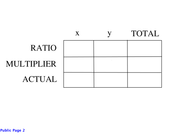
Image

Since x:y = 4:5, the total for the ratio is 9:
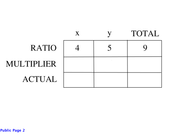
Image

Since the actual total of x and y is 117, we get:
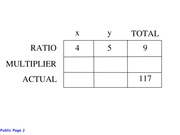
Image

Since (actual total)/(ratio total) = 117/9 = 13, the multiplier for the box is 13, as follows:
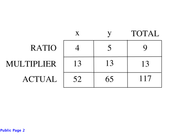
Image
Thus, x = 52 and y = 65.

From here, we can PLUG IN THE ANSWERS for the value of k.
When the correct value is subtracted from x and y, the resulting ratio will be 3 to 4.

Answer choice A: k=1
(52-1)/(65-1) = 51/64.
Eliminate A.

Answer choice B: k=13
(52-13)/(65-13) = 39/52 = 3/4.
Success!

The correct answer is B.
Private tutor exclusively for the GMAT and GRE, with over 20 years of experience.
Followed here and elsewhere by over 1900 test-takers.
I have worked with students based in the US, Australia, Taiwan, China, Tajikistan, Kuwait, Saudi Arabia -- a long list of countries.
My students have been admitted to HBS, CBS, Tuck, Yale, Stern, Fuqua -- a long list of top programs.

As a tutor, I don't simply teach you how I would approach problems.
I unlock the best way for YOU to solve problems.

For more information, please email me (Mitch Hunt) at [email protected].
Student Review #1
Student Review #2
Student Review #3
Join the discussion

by j_shreyans » Sun Feb 01, 2015 3:47 am
Hi All ,

One thing why cant we take one number be "a" and the second number be "b"?

Please suggest and advise.

Thanks

Shreyans
Join the discussion

by [email protected] » Sun Feb 01, 2015 1:06 pm
Hi j_shreyans,

As a general rule, using fewer variables makes the work easier/faster.

In this question, you COULD use A and B to refer to the two initial values. You could then form the following 3 equations:

A/B = 3/4

(A+K)/(B+K) = 4/5

(A+K) + (B+K) = 117

From here, the algebra is essentially the same, but it's a bit more layered and would probably take a bit longer to solve. On Test Day, on any given question, you have 2 goals:

1) Get the question correct (without spending too much time on it).
2) Solve in the least amount of time as possible.

If you find that you're getting questions correct, but it's taking too long to do so, then it might be that "your way" of solving is the "long way."

GMAT assassins aren't born, they're made,
Rich
Contact Rich at [email protected]
Image
Join the discussion

by wings.ap » Sat Aug 29, 2015 2:13 am
Hi all,

My approach was, if the ratio is 3:4 then the whole number will be divisible by 7.

K was added twice to the sum of both the numbers. So if we put the options

then 117 - 2*1 = 115 not divisible by 7.
117 - 2*13 = 91 divisible by 7.

If you check rest of the answers none will be divisible by 7.

So answer must be B.
Join the discussion

by RobertP » Sat Jan 23, 2016 10:48 am
This is how I did it. Please comment with opinions.

x/y = 3/4 => x = 3/4y

Then I used the second statement:

x+k/y+k = 4/5. I cross multiplied and substituted x with 3/4y and got k = 1/4y.

Used final formula:

(x+k) + (y+k) = 117. Substituted x and k for the values of y and ended up with the formula (3/4y + 1/4y) + (y + 1/4y) = 117 and solved for y. y = 52.

As k = 1/4y, divided [spoiler]52/4[/spoiler] and got the final answer.

B
Join the discussion

by [email protected] » Sat Jan 23, 2016 5:55 pm
Hi RobertP,

Most GMAT questions can be approached in more than one way, so your approach (although a bit Algebra-heavy) is just as valid as any other. It's important to keep in mind a couple of things though:

1) Is the approach you're using ultimately faster/easier than any other approach that you could use?
2) Are you maximizing your overall performance on the section when choosing this type of approach (or are you running out of time or still missing out on some points)?

GMAT assassins aren't born, they're made,
Rich
Contact Rich at [email protected]
Image
Join the discussion

by sagarmak35 » Mon May 30, 2016 11:50 pm
The ratio of two positive numbers is 3 to 4. If k is added to each number the new ratio will be 4 to 5, and the sum of the numbers will be 117. What is the value of k?
Ans Choices
1
13
14
18
21
We have to find k
The new ratio is 4:5 after adding k so every 9 units are in ratio of 4:5 hence it can be said that the answer can be determined as sum=117 so 117/9=13 so ans=B..... Thanks GMATPREPNOW for free video course
Join the discussion

by danielle07 » Sat Sep 02, 2017 1:53 am
Question:

How to do a simple solution to this?
Join the discussion

dhiren8182 wrote:
Sat Jan 17, 2015 7:28 pm
The ratio of two positive numbers is 3 to 4. If k is added to each number the new ratio will be 4 to 5, and the sum of the numbers will be 117. What is the value of k?
Ans Choices
1
13
14
18
21
OA 13
Not able to figure out on how my approach should be
Regards,
Dhiren
Since the ratio of the numbers is 3 to 4, the two numbers can be expressed as 3x and 4x for some positive value x.

Since the ratio after k is added to each number is 4 to 5, we can create the following equation:

(3x + k)/(4x + k) = 4/5

15x + 5k = 16x + 4k

k = x

Since the sum of the two numbers after adding k to each of them is 117, we have:

(3x + k) + (4x + k) = 117

(3x + x) + (4x + x) = 117

9x = 117

x = 13

Thus, k = x = 13.

Answer: B

Scott Woodbury-Stewart
Founder and CEO
[email protected]

Image

See why Target Test Prep is rated 5 out of 5 stars on BEAT the GMAT. Read our reviews

ImageImage
Join the discussion




















