| View previous topic :: View next topic |
| Author |
Message |
shahpuja Just gettin' started!
Joined: 23 Aug 2007 Posts: 2
Thanks given: 0 Thanked 0 times in 0 posts
Location: minneapolis
|
Posted: Wed Mar 05, 2008 10:08 pm Post subject: CR question |
|
|
28. (1) All A are B.
(2) Some B are C.
Which of the following is true?
(A) All A are C.
(B) No A are C.
(C) Some A are C.
(D) No C are A.
(E) None of the above.
I picked C. correct ans[color=white] E[/color]
please advise, my logic was that if a is part of b and some b is part of c, it is possible for some a to be part of C. why is that incorrect?
|
|
| Back to top |
|
 |
|
|
ikant Rising GMAT Star
Joined: 05 Mar 2008 Posts: 60
Thanks given: 0 Thanked 5 times in 5 posts
Location: mumbai, India Target GMAT Score: 750+
|
Posted: Wed Mar 05, 2008 10:46 pm Post subject: |
|
|
Hello,
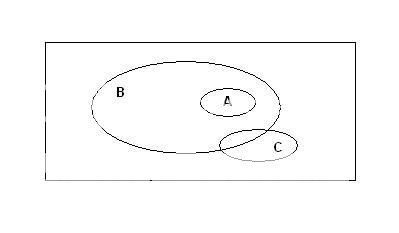
In such questions the most important point is to imagine a situation that encapsulates every possibility. You will see in the attached image the Venn Diagram that satisfies both the conditions and satisfies every possibility of interpretation.
_________________ "To do is to be" |
|
| Back to top |
|
 |
Stuart Kovinsky GMAT Instructor

Joined: 08 Jan 2008 Posts: 1057
Thanks given: 0 Thanked 151 times in 139 posts
Location: Toronto GMAT Score: 800
|
Posted: Wed Mar 05, 2008 11:48 pm Post subject: Re: CR question |
|
|
| shahpuja wrote: | 28. (1) All A are B.
(2) Some B are C.
Which of the following is true?
(A) All A are C.
(B) No A are C.
(C) Some A are C.
(D) No C are A.
(E) None of the above.
I picked C. correct ans E
please advise, my logic was that if a is part of b and some b is part of c, it is possible for some a to be part of C. why is that incorrect? |
Venn diagrams are one way we can keep track of this type of information, although the diagram provided by ikant is actually NOT an accurate representation.
Let's examine the two rules we have:
(1) all A are B.
From this, we know that if something is A, it's also B.
(2) Some B are C.
From this, we know that there's at least one B that's also C.
If we put the two statements together, we don't know anything for sure. Could some A also be C? Sure, but it's not definite.
Let's use a real-life example to make that clear:
All Dogs are Mammals.
Some Mammals are Cats.
Does this mean that some dogs are cats? Of course not!
Going back to your point, it may just be that you misinterpreted the question.
"Which of the following IS true?" means that we're looking for something that MUST be true. In your own words, all that we can conclude is
| Quote: | | it is possible for some a to be part of C |
which doesn't match what the question is asking.
_________________ Stuart Kovinsky, B.A. LL.B.
Academic Co-ordinator
Kaplan Test Prep & Admissions
Toronto Office
1-800-KAP-TEST
Learn more about me |
|
| Back to top |
|
 |
ikant Rising GMAT Star
Joined: 05 Mar 2008 Posts: 60
Thanks given: 0 Thanked 5 times in 5 posts
Location: mumbai, India Target GMAT Score: 750+
|
Posted: Thu Mar 06, 2008 1:48 am Post subject: |
|
|
Hi,
You are right..I just realised the mistake I did in drawing the diagram. There is actually no single Venn diagram possible to be drwan for this preposition.
_________________ "To do is to be" |
|
| Back to top |
|
 |
Kekela Just gettin' started!
Joined: 14 Jan 2008 Posts: 7
Thanks given: 0 Thanked 0 times in 0 posts
Test Date: 4 May Target GMAT Score: >
|
Posted: Mon Mar 10, 2008 3:17 am Post subject: Solution |
|
|
...
|
|
| Back to top |
|
 |
|
|
rajmirra Rising GMAT Star
Joined: 08 Jan 2008 Posts: 65
Thanks given: 4 Thanked 3 times in 3 posts
Location: Canada
|
Posted: Mon Mar 10, 2008 8:03 am Post subject: |
|
|
I dont remember this format of the question in any GMAT material. I have seen the question in IIM- CAT India. The question certainly is triggering you to think critically. But the real trick in GMAT is how you decipher the question and reach this stage (as stated in question). Has anyone seen this type of question in real GMAT?
Thanks.
~R
|
|
| Back to top |
|
 |
michelsmithm Rising GMAT Star
Joined: 10 Mar 2008 Posts: 30
Thanks given: 0 Thanked 0 times in 0 posts
Location: Florida
|
Posted: Fri Mar 28, 2008 4:00 am Post subject: |
|
|
| No i have also not seen such questions i agree with rajmirra.
|
|
| Back to top |
|
 |
Stuart Kovinsky GMAT Instructor

Joined: 08 Jan 2008 Posts: 1057
Thanks given: 0 Thanked 151 times in 139 posts
Location: Toronto GMAT Score: 800
|
Posted: Fri Mar 28, 2008 10:19 am Post subject: |
|
|
This is much more of an LSAT style than GMAT style question. It's very rare for the GMAT to test you on formal logic.
_________________ Stuart Kovinsky, B.A. LL.B.
Academic Co-ordinator
Kaplan Test Prep & Admissions
Toronto Office
1-800-KAP-TEST
Learn more about me |
|
| Back to top |
|
 |
michelsmithm Rising GMAT Star
Joined: 10 Mar 2008 Posts: 30
Thanks given: 0 Thanked 0 times in 0 posts
Location: Florida
|
Posted: Mon Mar 31, 2008 4:15 am Post subject: |
|
|
Thanks stuart for explanation but please provide some guidance where i can find such questions just for general practice.
|
|
| Back to top |
|
 |
Stuart Kovinsky GMAT Instructor

Joined: 08 Jan 2008 Posts: 1057
Thanks given: 0 Thanked 151 times in 139 posts
Location: Toronto GMAT Score: 800
|
Posted: Mon Mar 31, 2008 9:51 am Post subject: |
|
|
| michelsmithm wrote: | Thanks stuart for explanation but please provide some guidance where i can find such questions just for general practice.  |
If you really want to practice this type of question (which is fairly rare on the GMAT), then I'd suggest LSAT materials which focus on the logical reasoning section of that test - especially inference questions.
If you want a better understanding of formal logic (and you only need to know the VERY basics, even for the LSAT), I'd look for a primer on if-then statements. The formal logic tested on the GMAT is minimal and even on the LSAT it's only what one would learn in the first week of a university level course.
_________________ Stuart Kovinsky, B.A. LL.B.
Academic Co-ordinator
Kaplan Test Prep & Admissions
Toronto Office
1-800-KAP-TEST
Learn more about me |
|
| Back to top |
|
 |
|
|
jamess Rising GMAT Star
Joined: 12 Apr 2008 Posts: 50
Thanks given: 0 Thanked 0 times in 0 posts
|
Posted: Tue Apr 15, 2008 8:56 am Post subject: Re: CR question |
|
|
| shahpuja wrote: | 28. (1) All A are B.
(2) Some B are C.
Which of the following is true?
(A) All A are C.
(B) No A are C.
(C) Some A are C.
(D) No C are A.
(E) None of the above.
I picked C. correct ans E
please advise, my logic was that if a is part of b and some b is part of c, it is possible for some a to be part of C. why is that incorrect? |
E is the correct answer.
You should draw a venn diagram to solve this type of question.
Here it is
_________________ Check out <a href="http://gmatadvice.blogspot.com">gmatadvice.blogspot.com</a> for useful tips to ace the GMAT.
<a href="http://gmatadvice.blogspot.com/2008/04/launched-ebook-on-critical-reasoning.html">ebook on critical reasoning</a> launched. |
|
| Back to top |
|
 |
|